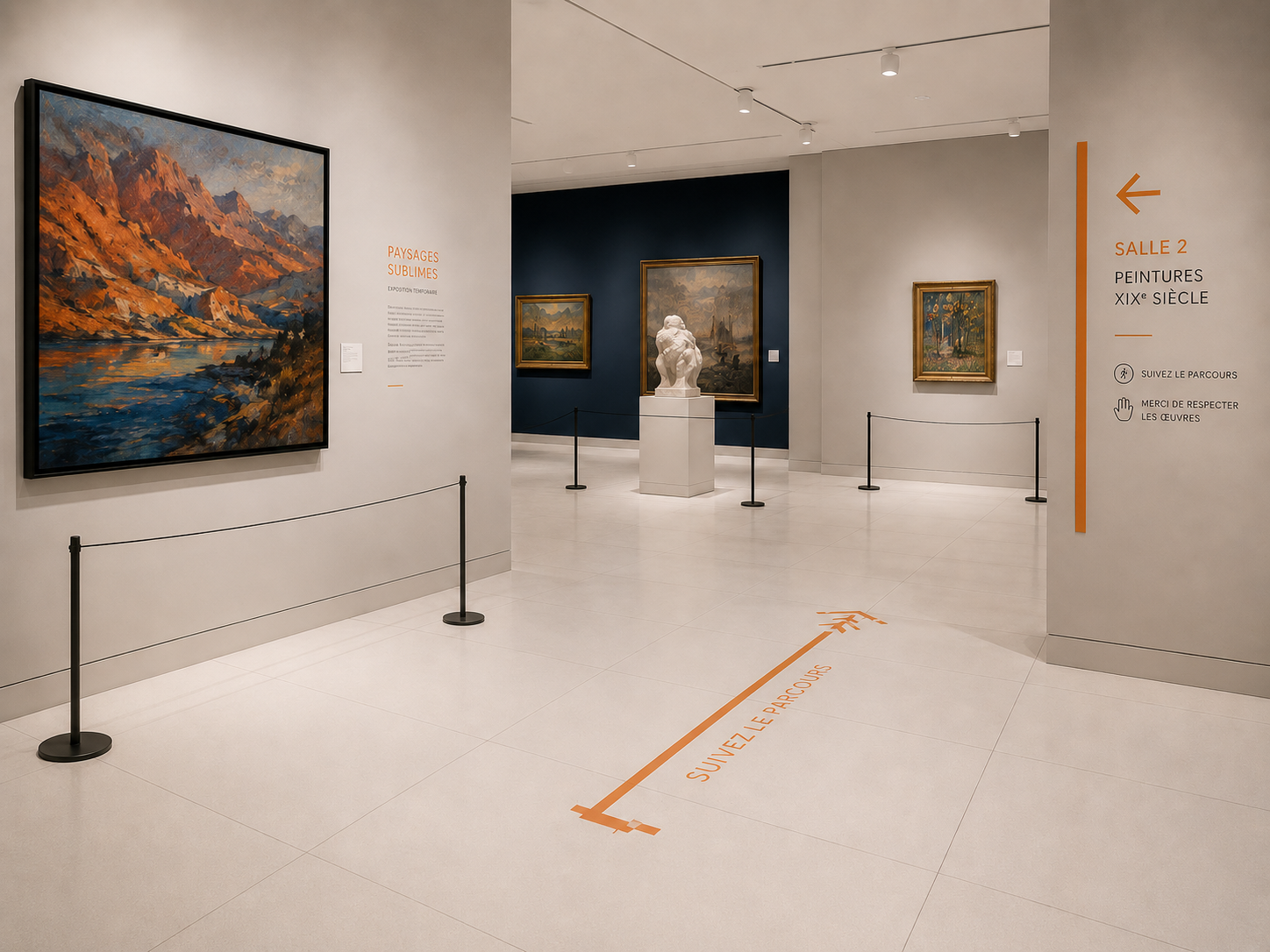
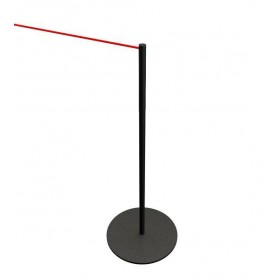
The museum rope barrier post is the reference equipment for museum institutions, art galleries, exhibition centres and demanding cultural venues. Its discreet design and elastic rope stretched approximately 20 centimetres from the floor create a boundary that is both effective and visually minimalist, protecting artworks and furnishings without compromising the visitor experience. Stand-Direct offers a complete range of museum barrier posts suited to all exhibition contexts.
In a museum or gallery, the challenge of crowd control is paradoxical: protecting artworks while remaining unobtrusive. The museum rope barrier post meets this requirement perfectly. The rope stretched close to the floor creates a perceptible boundary without obscuring the sightline to the artwork, and its modest height avoids the deterrent barrier effect of conventional crowd management systems. The posts themselves, approximately 50 to 70 centimetres in height, are designed with understated finishes (matte black, brushed chrome, antique gold) that integrate seamlessly into any exhibition design.
Our range offers several finishes to match different museum environments: matte black for contemporary spaces and modern art galleries, aged brass or antique gold for traditional museums (fine arts, decorative arts, historic châteaux), brushed chrome for modern exhibition centres and design spaces, satin stainless steel for technical and scientific exhibitions. The elastic rope is generally available in black, burgundy or antique gold to harmonise with the chosen finish.
Museum barrier posts feature heavy weighted bases (from 5 to 12 kilograms depending on the model) that ensure perfect stability without requiring permanent floor fixings. This characteristic is essential in listed historic buildings or museum spaces where no floor penetration is permitted. The standard circular bases (30 to 40 cm in diameter) remain sufficiently discreet not to impede visitor flow or the legibility of the exhibition route.
One of the great advantages of the system is its total modularity. The posts can be repositioned in seconds, and the elastic rope clips on and off easily via press-fit end connectors. This operational flexibility is invaluable for temporary exhibitions that regularly change layout, late-night events requiring adapted configurations, and conferences or special events requiring differentiated circulation routes. Curators and exhibition managers appreciate this flexibility, which allows them to adapt the barrier layout to each new hanging without technical intervention.
The museum barrier post is part of our crowd control and barrier range, which covers all flow management and protection needs in public environments. For braided rope posts designed for luxury hospitality, or for retractable belt barrier posts suited to high-traffic areas, please visit our dedicated categories. Delivery to the United Kingdom, Belgium, Luxembourg, the Netherlands and Germany within 24 to 72 hours.
In a museum or exhibition centre, the museum barrier post serves several complementary functions: it establishes the minimum safety distance around each artwork (typically 50 to 80 cm depending on the piece), it guides visitors along the route suggested by the exhibition curator, and it physically protects sensitive or high-value works from accidental contact. This triple function explains its systematic presence in virtually all European museum institutions.
For particularly valuable or fragile artworks, double the setup: a first barrier line at 50 cm from the work, then a second at 1 metre forming a security buffer zone. This precaution is appreciated by insurers and conservators for major collection pieces. For family or young audience exhibitions, complement the setup with appropriate educational signage to explain in simple terms the importance of respecting the displayed works.
For commercial art galleries and temporary exhibition spaces, modular crowd management is essential. Exhibitions follow one another at a rapid pace (every 4 to 8 weeks on average), each with its own scenography, preferred visitor flow, and specific artworks to protect. Museographic rope barrier posts offer the reconfiguration flexibility required to keep up with this intense rhythm.
For vernissages and gallery events, the barriers can be temporarily removed or repositioned to create a cocktail or presentation area. Returning to the standard visitor configuration takes just a few minutes. For galleries wishing to offer a true artwork journey with a dedicated discussion space, complement with a reception rope post in a matching finish to visually distinguish the exhibition area from the welcome or café zone. Wall-mounted plexiglass signage can accompany each artwork with its descriptive information.
For the protection of artworks displayed at floor level (sculptures, installations, low display cases), posts ranging from 50 to 60 centimetres in height are perfectly suited. An elastic rope tensioned at 50 centimetres from the ground creates an effective safety perimeter while remaining visually unobtrusive. For artworks displayed on a plinth or at height, taller posts (95 cm) improve the visibility of the barrier from a distance and more clearly signal the boundary to adult visitors who do not habitually look down at floor level.
The minimum distance recommended by most curators is 50 centimetres between the barrier and the artwork, which is enough to prevent any accidental contact from a visitor leaning forward. For particularly valuable, fragile or large works, increase this distance to 80 cm or 1 metre. This buffer zone also protects against accidental splashes (drinks, perfumes, particles) and facilitates dusting operations or monitoring by reception and security staff.
No, our museum posts feature heavy weighted bases that provide perfect stability without any permanent fixings. This is essential in listed historic buildings and spaces with protected flooring (antique parquet, marquetry, period stone flags) where drilling is strictly prohibited. The base weight, typically between 5 and 12 kg depending on the model, ensures sufficient resistance to accidental contact from visitors with no risk of tipping.
The museum post is designed for the static protection of displayed artworks: it remains in place for several weeks or months, its elastic rope is discreet and visually integrated into the scenography. The retractable belt post is designed for dynamic crowd and queue management in retail, banking or administrative environments: the belt extends and retracts as needed, making it more visible and functional. Both solutions serve very different purposes and are generally not interchangeable.
Yes, the elastic rope is a consumable part that can be replaced independently of the post. Standard models in our range accept all compatible replacement ropes, available individually or in packs. The pressure-fit end caps allow for a change in seconds, with no tools required. For intensive use (high-traffic museums), we recommend preventive rope replacement every 2 to 3 years to maintain optimal tension and a flawless appearance.
Our standard models are designed for indoor use in controlled museum environments. For outdoor applications (sculpture gardens, museum forecourts, open-air exhibitions), specific anti-corrosion treated models are available in brushed stainless steel finish. Please confirm the "outdoor" specification with our team before ordering. For temporary outdoor exhibitions, alternative demarcation solutions such as customisable advertising barriers may also be suitable depending on your context.
The reconfiguration between two setups is one of the system's key advantages: weighted-base posts are simply relocated by lifting and placing them in their new position. Elastic ropes detach with a single press and can be stored coiled with their length label. A production crew can reconfigure an entire room's layout (10 to 20 posts) in under an hour. Keep a few spare posts and ropes in reserve for last-minute adjustments based on each exhibition's specific requirements.
For a large floor-based artwork (monumental sculpture, installation, long display case), plan for one post at each corner plus one additional post every 1.5 metres along the perimeter. For example, for a 3-metre x 2-metre artwork with a 50 cm clearance all around, approximately 8 to 10 posts will be needed for clean, professional crowd control. For wall-mounted works (paintings, panels) where distance is maintained in a single line facing the piece, two posts and a tensioned rope running parallel may be sufficient.
Several complementary accessories enhance your display system: plexiglass label holders for artwork information, wall mounts for elastic rope attachment, signage... For directional signage between rooms, complete your setup with an interchangeable door sign that allows you to easily update information according to current exhibitions. Together, they create a cohesive and professional environment that meets the demands of contemporary museographic standards.
Can't find the answer to your question ?
The choice of museum barrier post depends on several criteria specific to the cultural sector: type of works on display, overall exhibition scenography, architectural constraints of the venue, expected visitor flow, and desired operational flexibility. A well-designed barrier system becomes invisible to the visitor while perfectly fulfilling its protective function.
For fine art and traditional decorative arts museums, aged brass or antique gold finishes harmonise beautifully with wooden panelling, period parquet floors, and heritage works. An elasticated rope in burgundy or antique gold completes the aesthetic harmony. Conversely, for a contemporary art centre or design gallery, opt decisively for matte black or brushed chrome finishes that recede into the visual minimalism of the white-walled space.
Regarding post height, standard models between 50 and 60 centimetres are suited to protecting floor-level works (sculptures, installations, low display cases) and create a respectful buffer zone of approximately 50 centimetres from the artwork. For exhibitions where works are suspended or presented at eye level, taller posts (70 to 80 cm) may be preferable to ensure the barrier remains visible from a distance.
The spacing between posts is a criterion that is often underestimated. Too far apart (more than 2 metres), the posts allow the rope to sag visually and lose its deterrent effect. Too close together (less than one metre), they create an overcrowded furniture effect that is visually unappealing. The optimum range lies between 1.2 and 1.8 metres, depending on the weight of the rope and the visual context of the space.
For temporary exhibitions requiring frequent reconfiguration, favour modular models with removable bases and quickly detachable ropes. This operational flexibility is invaluable for installation managers who change their display layout every two to three months and must adapt the barrier arrangement to each new scenography. For spaces frequented by family audiences, child-height barrier posts can be complemented with an interchangeable door sign displaying visit guidelines to observe.
Active filters: