Statut en temps réel de votre commande et de votre livraison.
The fixing accessories in this range let you securely install an advertising banner, a bunting strip or an outdoor communication display on a facade, fence or existing structure, without a permanent fitting. They suit retailers, event organisers and local authorities who need to stretch a large format visual while keeping it stable against wind and weather for the whole length of the campaign. Each reference addresses one specific point in the fixing chain: hooking, tensioning, guiding or reinforcing an anchor point, depending on the type of surface and where the banner needs to go.
Large format advertising banners, temporary bunting and outdoor flags aren't fixed the same way: a banner stretched on a rigid frame needs regular anchor points all round its edge, while a banner suspended between two structures only needs a few solid points at each end. This variety of setups explains the range of accessories on offer, each calibrated for a specific use rather than a one-size-fits-all solution.
Hook-based fixing systems allow quick installation and removal without special tools, a decisive advantage for temporary campaigns where the banner needs to go up and come down within minutes. Double-hook models spread the tension across two points at once, reducing the strain on each eyelet of the banner and cutting the risk of tearing at the attachment points.
Choosing the right accessory starts with the size and weight of the visual to be installed: a small format needs only light fittings, while a banner covering several square metres and exposed to wind needs stronger, more numerous fixing points to spread the load across the whole structure.
Constantly exposed to UV, rain and temperature swings, these outdoor fixing accessories need to keep their elasticity and mechanical strength over time. An accessory that loses tension over time lets the banner flap in the wind, which speeds up wear on the printed visual and eventually weakens the eyelets themselves.
Designed to be reused from one campaign to the next, these accessories simplify the logistics for teams who regularly put up and take down outdoor communication displays: a flat double-hook fixing kit packs away easily between installs and keeps its performance over several seasons of use.
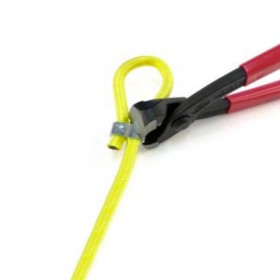
Metal tensioners, ratchet straps, bungee cords: absorb dimensional variations to protect your tarp.
Complete kits for standard tarp installation: eyelets, tensioners, and wall-mounted fixtures included.
For a durable installation, opt for nickel-plated brass eyelets Ø12 mm, set every 30 to 50 cm around the full perimeter of the banner. This eyelet spacing spreads tension evenly and prevents tearing of the 510 g/m² PVC in strong wind. Anti-tear eyelets with a wide washer suit large facade formats, while standard eyelets are enough indoors. Reinforce the corners, the most stressed points, with a heat-welded hem. All our eyelets are treated to be UV and weather resistant, ensuring a service life of 2 to 5 years in permanent outdoor use.
The choice depends on wind exposure. Elastic bungee cords (sandow) with rubber hook loops or S-hooks absorb gusts: their elasticity cushions impacts and protects the eyelets on highly exposed banners. Screw tensioners or stainless steel turnbuckles, by contrast, deliver a fixed, rigid tension, perfect for a perfectly taut finish on a frame or grid. In practice, combine rubber bungee loops on the windward sides with tensioners on the fixings to a rigid frame. All our accessories are made from UV-resistant materials for prolonged outdoor use.
Basic rule: one fixing point every 30 to 50 cm around the perimeter, never more than 50 cm between two eyelets on windward edges. For a 3x2 m banner, plan for around 20 to 24 fixings (eyelet + tensioner or elastic loop). Beyond 6 m², tighten the spacing to 30 cm and add central eyelets to limit flapping in the wind. Always count on one S-hook or rubber loop per eyelet, plus 10% in reserve. An under-fixed banner tears at the corners: it is better to multiply the anchor points than to risk a rupture.
The accessory budget stays modest compared to the cost of the banner. Count a few cents per additional eyelet, around €0.10 to €0.50 per rubber loop or S-hook, and €1 to €3 per stainless steel screw tensioner. A complete installation kit (sandow cords, carabiners, hooks) for a 3x2 m banner generally costs between €15 and €40 depending on quality. Favour UV-resistant stainless steel accessories: the saving made on cheap items is quickly cancelled out by a torn banner. The extra cost of durable fixing represents a fraction of the price of the printed banner.
The fixing accessories (eyelets, S-hooks, rubber loops, sandow cords, stainless steel tensioners) are standard items kept in stock: dispatch generally within 24 to 48 hours of order confirmation. You receive your complete installation kit within a few working days, ideal for finalising an urgent installation or topping up an existing stock of fixings. For bulk orders of tensioners or elastic cords, the lead time may vary slightly but stays short. We recommend ordering accessories and banner together so that you have a ready-to-install fixing solution on arrival.
Can't find the answer to your question ?
How reliably a banner performs outdoors doesn't just depend on print quality or the strength of the material itself: it rests above all on getting the fixing system right, often treated as a minor detail even though it determines how well the whole thing holds up against the wind. A banner stretched with undersized or poorly spaced accessories deforms, flaps and eventually tears at the eyelets, forcing the replacement of a still-recent visual well before the end of its expected lifespan. Investing in the right fixing accessories from the first installation avoids this kind of loss and actually protects the budget spent on printing, which is usually the most expensive part of the whole job.
Installation technique varies depending on whether the banner is fixed to a rigid frame, stretched between two existing structures, or fitted to a site fence: in the first case, even, moderate tension all round the edge avoids twisting the visual, whereas fixing between two distant anchor points needs stronger tension to limit flapping in the wind. Excessive tension concentrated on too few points consistently weakens the eyelets, which eventually tear under repeated gusts.
A banner installed on a facade or an exposed fence faces very different stresses depending on the season: prolonged exposure to winter weather gradually weakens elastic accessories, which lose responsiveness and need checking more often during this period. On a particularly windy site, it's better to plan for more anchor points than usual rather than compensate with stronger tension on fewer fixings, which simply shifts the risk of failure to a single point.
Fixing accessories left outdoors continuously gradually lose elasticity and mechanical strength, a process sped up by UV exposure and temperature swings. Regular visual checks, especially before a forecast period of high wind, help spot a worn accessory before it fails and causes the whole visual to come loose. Keeping a stock of spare parts means a communication campaign never needs to be interrupted for an emergency replacement.
Site fencing, aluminium framework, a masonry facade or an existing fence don't offer the same natural attachment points: rigid fencing readily accepts quick-release hooks spread along its height, while a facade with no built-in anchor point often needs extra eyelets added or supporting structures brought in. Checking the nature of the surface before choosing accessories avoids buying a mismatched system that has to be replaced once the install is already underway.
The most common issues come from mixing accessories from different generations or with different strength ratings on the same banner, which creates uneven tension points, or from fixing directly onto an eyelet with no load-spreading fitting, concentrating all the strain on a single weak point. Combining several types of accessory, for example hook fixings at the corners and reinforcing rings at intermediate points, spreads the load better and extends the life of the whole installed visual. One last classic mistake is reusing accessories from a previous campaign, already worn after months of outdoor exposure, without checking them, when a simple visual check before each new installation is enough to rule out parts that no longer guarantee a reliable hold.
Active filters: