Statut en temps réel de votre commande et de votre livraison.
A magnetic board combines a dry-erase writing surface with a magnet-receptive backing, allowing you to both write with a marker and display documents, schedules or visuals without pins or adhesive. This dual function makes it a central working tool in offices, meeting rooms, production workshops and schools, wherever information needs to be visible, editable and shared by several people. Unlike a simple whiteboard, a magnetic surface allows notes, printed schedules or lightweight items to be attached instantly, then moved or removed without leaving a mark. The range covers everything from a small desktop model to a large wall-mounted format designed for a meeting room or an open-plan office.
In a meeting room, the magnetic whiteboard serves as both a presentation surface and a brainstorming space, with the option of attaching cards or plans alongside written notes. In a workshop or industrial setting, it becomes a visual management board on which production schedules, indicators or safety instructions are displayed using magnets, a common practice in visual management methods. In shared offices, it helps organise a team schedule or track project progress collaboratively.
Formats range from a compact model on a mobile stand, easy to move between rooms, through to a large fixed wall board that anchors a meeting room long term. The frame around the surface contributes both to the board's rigidity and to how it fits into the space: a slim, discreet frame suits a polished office environment, while a wider frame makes it easier to attach additional accessories.
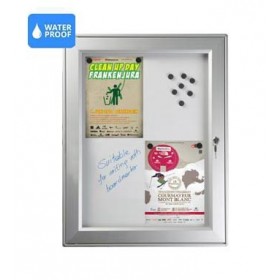
Certain professional environments, building sites, industrial site entrances or outdoor display points, need a magnetic surface able to withstand the weather. An outdoor display case applies this same magnetic display principle in a weatherproof version, protecting displayed documents from rain and dust while retaining the ability to update information quickly.
A magnetic board rarely works alone: magnets, dry-erase markers and sometimes an accessory holder complete the setup for comfortable everyday use. The choice of magnet strength depends on the weight of the documents being displayed, with a full plan or file needing stronger holding power than a simple note sheet.
For occasional office use, a standard-format whiteboard covers most needs, while an intensive collaborative working environment justifies a larger format or a reinforced surface able to withstand repeated cycles of writing and display over several years.
In offices and meeting rooms, the magnetic board is a versatile internal communication tool: displaying documents, visual planning of projects, writing down ideas in meetings. Discreet aluminum frame suitable for all tertiary environments. Complete with a wall-mounted clic-clac frame for formal displayed communications.
In schools, universities and training rooms, the large format magnetic board is the central teaching tool: writing ideas, displaying visual aids, visual planning of workshops. Combine with interior signage for orientation and identification of rooms.
The choice of format depends on the number of users and reading distance. For an individual office, a 60x90 cm board is enough to organize tasks and reminders. In a meeting room, choose a large format 100x150 cm or 120x200 cm so that the lacquered steel surface remains readable from the back of the room. Allow approximately 30 cm of visible surface area per participant for comfortable brainstorming. A rigid aluminum frame guarantees flatness on these large dimensions and facilitates wall mounting, without deformation over time.
Yes, the dual function is the major advantage of this support. The surface in enamelled lacquered steel is both magnetic and perfectly smooth, designed for writing with a dry-erase marker (Velleda type). You write down agendas, schedules and diagrams, then erase with a simple wipe of a dry cloth without leaving a trace or ghost shadow. At the same time, magnets hold documents, photos or notes. For intensive daily use, vitrified enamel is more resistant to scratches and guarantees lasting erasability, whereas a standard lacquer can mark after several years.
Count approximately one magnet every 15 to 20 cm of display edge. For a 60x90 cm board, a set of 10 to 12 magnets covers current needs; for a large format 120x200 cm in a meeting room, plan for 20 to 30 units. Choose the strength according to the load: 20-30 mm round magnets hold a single A4 sheet, while powerful neodymium magnets hold several stacked documents or a cardboard folder. On a lacquered steel surface, the grip is firm and without slipping. Always have a few spare magnets for display picks.
The magnetic board also allows documents to be fixed using magnets. Almost all modern magnetic boards are also Velleda compatible. For pure writing intensive use, a pure Velleda has a slightly better erasing quality.
The choice depends on your decorative universe and the intensity of use. The anodized aluminum frame is the professional standard: light, rigid, insensitive to humidity, it is suitable for open spaces, meeting rooms and communities with high traffic. It often includes a felt holder shelf and guarantees lasting flatness on large formats. The noble wood frame provides a warm finish suitable for high-end executive offices, practices and reception areas. In both cases, the surface remains a magnetic lacquered steel dry erase, identical in writing performance.
A quality magnetic board easily lasts 10 to 15 years in daily office use. Longevity depends on the surface: vitrified enameled steel is almost scratch-proof and retains its erasability even after thousands of writings, whereas an entry-level lacquer can mark in 2 to 4 years. The aluminum frame does not rust and is resistant to shocks in meeting rooms or communities. Our tables are made in Europe for intensive use. To extend life, use a suitable erasable marker and dry eraser, and avoid permanent markers.
A large format (from 120x200 cm) requires solid and distributed wall mounting. Choose a wall fixing kit with at least 4 points, with dowels adapted to the support: expansion dowels in concrete or solid brick, Molly type dowels in a plasterboard partition. On a hollow partition, it is essential to aim for the metal uprights or rails to distribute the weight of the steel panel and the aluminum frame. Place the board level, high point approximately 200 cm from the ground. For scalable use, high-power magnets or a rail system allow repositioning without new drilling.
Standard magnetic boards in stock (common formats 60x90, 90x120, 100x150 cm, aluminum frame) are shipped within 24 to 48 hours and delivered within a few working days. For very large formats, noble wood frames or specific configurations, allow a slightly longer lead time. As our tables are manufactured in Europe, deadlines remain under control even for large orders intended to equip several meeting rooms. Large formats travel packaged on pallets with corner protection, lacquered steel surface preserved until wall installation.
Can't find the answer to your question ?
Investing in a professional magnetic board rather than in a simple whiteboard is justified as soon as the display changes on a daily basis: schedules, project monitoring documents, job descriptions or indicators which must be added, moved or removed without going through printing or taped paper display. This range naturally finds its place in visual management approaches and collaborative project management methods, where the team physically moves elements on the board as progress is made. The choice of the right model depends above all on the frequency of use and the context: an occasional meeting room does not have the same needs as a production workshop which updates its board several times a day.
A board fixed to the wall is suitable for sedentary use, in a dedicated meeting room or a permanent workstation, with the advantage of a generally larger and more stable surface. A mobile free-standing model is essential when the same board must be used in several rooms, for traveling meetings or one-off workshops, often with a more compact format. For teams who regularly change rooms or floors, this mobile format avoids duplicating equipment and facilitates storage when the board is not in use.
The surface of a magnetic board is maintained with dry-erase markers specifically designed for this use: a permanent marker used by mistake leaves a mark that is difficult to remove and can seriously damage the coating. irreversible. Regular cleaning with a dry cloth or a dedicated product, rather than an aggressive solvent, helps maintain the whiteness and magnetic function of the surface over several years. It is also recommended to avoid leaving writings in place for too long, as certain inks can permanently mark a surface exposed to direct light.
Beyond the board itself, regular use requires providing consumables: erasable markers to be renewed regularly and additional magnets if display use increases. An additional set of magnets allows you to anticipate this use without finding yourself short of accessories during a meeting or an important display. On an intensively used board, this regular renewal of consumables should be anticipated as soon as the support is set up.
A growing team or a department that multiplies the projects monitored in parallel often ends up saturating a single board. Rather than replacing all of the equipment, it is possible to add a second compact format panel dedicated to a specific use, or to reserve a permanent area of the existing panel for recurring information such as indicators or fixed instructions. This progressive approach avoids over-sizing from the start a disproportionate format for a need that does not yet exist, while maintaining the possibility of evolving the equipment at the real pace of the activity.
Several errors regularly recur in the choice and use of a professional magnetic board: under-sizing the surface in relation to the volume of information to be displayed, which requires prematurely erasing elements that are still useful; install the board in an axis of direct light which hinders reading during the day; or even neglect wall mounting on a large format, which must support the weight of the painting as well as repeated handling without unsealing. Anticipating the actual display volume, even before choosing the size, avoids most of these inconveniences and guarantees a sustainable choice.
Active filters: