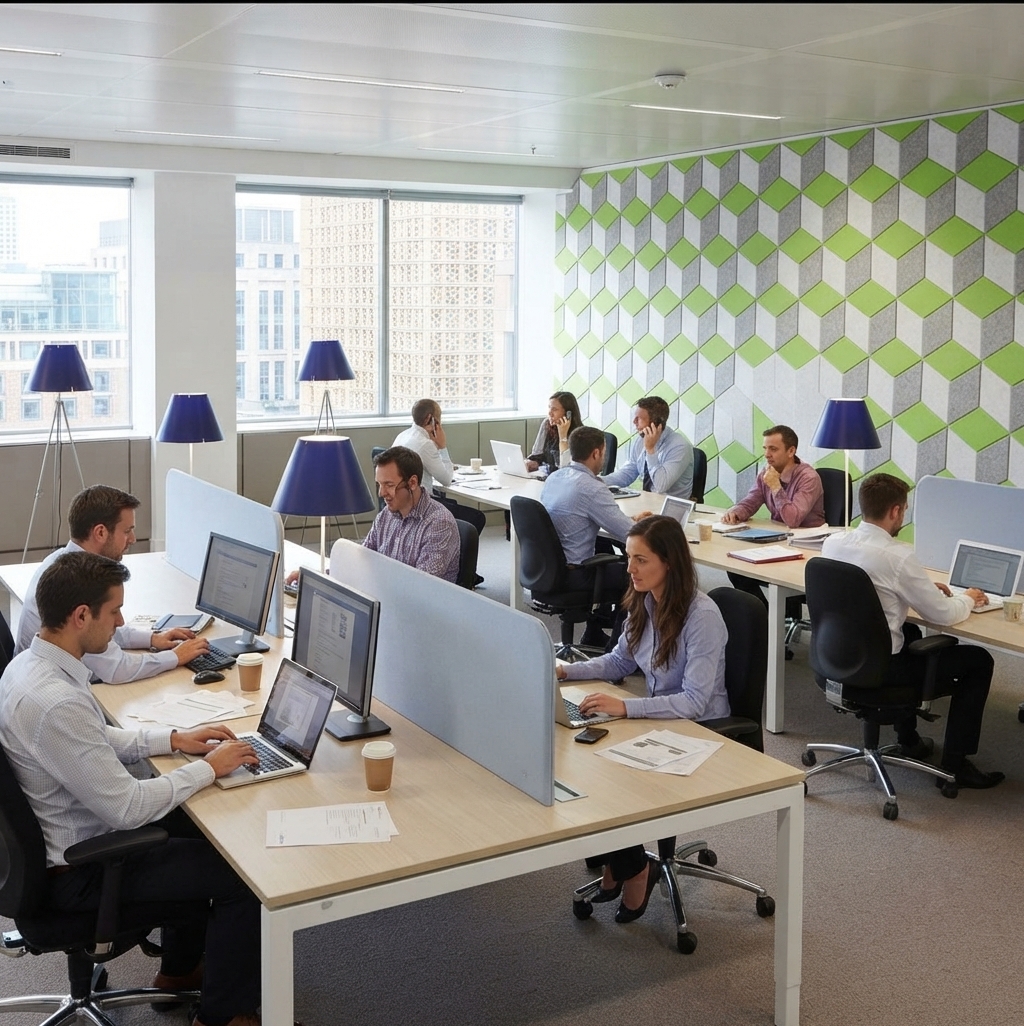
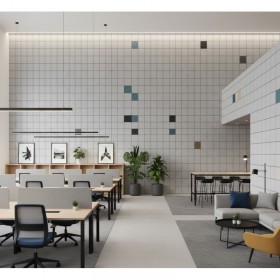
The wall acoustic panels are the most effective solution for reducing reverberation and improving sound comfort in modern office environments. Open-plan offices, meeting rooms, reception halls, training rooms, busy restaurants: their installation radically transforms the acoustic quality of a space and measurably improves concentration, speech intelligibility and user well-being.
In a space with hard surfaces (concrete, glass, mineral flooring, concrete ceiling), sound waves bounce endlessly, creating a reverberation that amplifies ambient noise. A conversation at 2 metres becomes audible at 8 metres, sounds accumulate and intelligibility drops. Acoustic panels made from absorbent materials (dense felt, melamine foam, clad mineral wool) capture these reflected waves and convert them into minimal heat, immediately reducing ambient noise by 6 to 12 dB depending on the configuration.
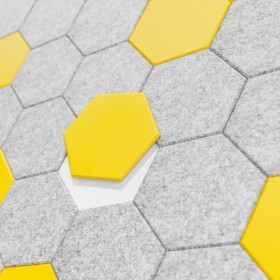
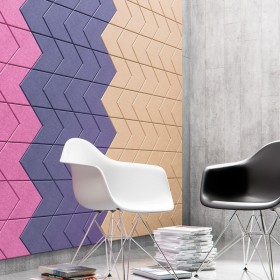
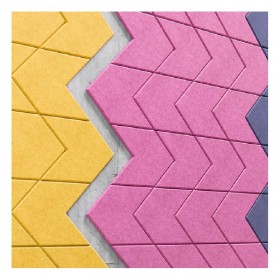
Modern acoustic panels are no longer the austere grey blocks of the 1990s. Our range offers more than 30 standard felt colours compatible with all corporate interior design schemes: from understated off-white to energising bright colours and reassuring natural tones. Customisable geometric shapes (rectangles, hexagons, triangles, freeform) turn acoustics into a genuine decorative feature that enhances your company image.
Our range covers the main panel types: direct-fix wall panels for suitable wall surfaces, ceiling-suspended panels on cables for high ceilings, free-standing floor panels for spaces where no fixing is possible. Acoustic desk screens provide targeted protection for individual workstations in open-plan offices. Each solution responds to a specific fit-out context.
The vast majority of our acoustic panels require no structural work: wall-mounted with standard plugs and fixings, suspended by cables from a false ceiling or directly from a concrete ceiling, or free-standing for modular models. This ease of installation allows quick deployment without disrupting office activity, and straightforward removal should a relocation be needed — a major advantage for tenants.
Wall acoustic panels are part of our complete acoustic solutions range, which also includes suspended acoustic light fittings. For complementary partitioning solutions, browse our mobile partitions. Delivery within 3–7 working days to the United Kingdom, Belgium, Luxembourg, the Netherlands and Germany for standard references.
Modern open-plan offices almost universally suffer from acoustic issues: conversations carrying across multiple workstations, reverberation off hard surfaces, and a cumulative background noise that becomes genuinely difficult to tolerate. Installing wall-mounted acoustic panels immediately reduces ambient noise by 6 to 12 dB depending on configuration — equivalent to cutting the perceived sound level by half or even two-thirds.
For optimal effectiveness, combine multiple solutions: wall panels on vertical surfaces, suspended acoustic lighting fixtures at ceiling level, and optionally individual acoustic screens between workstations. This multi-layered approach radically transforms the acoustic quality of any open-plan office. Complete the setup with acoustic lighting and modular partitioning to visually structure the space.
In meeting rooms, training rooms and lecture halls, speech intelligibility is the primary challenge. A room with poor acoustic correction generates echoes, loss of intelligibility and listener fatigue. Video conferences are particularly affected, with poor sound quality on the remote audience's side: the microphone picks up the room's echo, degrading the experience for remote participants.
The right acoustic treatment involves installing absorbing panels on 20 to 30% of the wall surface, prioritising the rear wall (facing the screen/board) and side walls. This modest investment (€1,500 to €3,000 for a 25 m² room) radically transforms the quality of exchanges and the professional perception of your space by visitors and colleagues.
For an 80 m² open-plan office, plan for 12 to 20 m² of total absorptive surface, which equates to approximately 8 to 14 wall panels measuring 1 m x 1 m. This quantity can be distributed as follows: 5 to 8 wall panels + 3 to 5 suspended acoustic light fixtures for maximum effectiveness. For particularly noisy environments (telephone workstations, large glazed surfaces), increase this quantity by 20–30%. Our technical team can assist you with precise sizing based on your floor plan.
Yes, professional-grade dense felt acoustic panels have a high sound absorption coefficient (αw between 0.75 and 0.95 depending on the model), equivalent to traditional mineral wool solutions. Their thickness of 9 to 24 mm provides effective absorption across the main frequencies of the human voice (250–4000 Hz), precisely the range where office noise is most disruptive. Acoustic tests in reverberation chambers confirm their performance.
For an open-plan office of 50 to 100 m², budget between €2,000 and €6,000 for an effective setup combining 8 to 16 wall panels + 4 to 8 acoustic light fixtures. For a premium installation with custom visual prints and individual acoustic screens, the budget can reach €10,000–€15,000. This investment pays for itself quickly through documented productivity gains (up to 30 minutes per employee per day).
Yes, custom visual printing on acoustic panels is possible: your logo, brand identity, decorative visuals or even art photography. This personalisation transforms acoustic correction into a visual communication and decoration tool. Ideal for visitor reception areas where aesthetics matter just as much as acoustic performance. Allow an additional lead time of 2 to 3 weeks for custom printed panels.
The wall panel treats reverberation on vertical surfaces: conversations between colleagues, horizontal sound propagation. The suspended ceiling panel (or combined acoustic luminaire) treats reverberation on the large horizontal surface of the ceiling, which accounts for 30-40% of the acoustic problem in the majority of offices. For optimal results, combine both approaches: wall treatment for direct conversations + ceiling treatment for general reverberation.
No, the vast majority of our acoustic panels can be installed without any major construction work. Wall mounting with standard fixings (plasterboard, BA13 board, brick), suspension via cables or ceiling rails, or freestanding floor panels. This simplicity allows for quick installation (1 to 2 days to fit out a 100 m² open-plan office) without disrupting office activities. For tenants, the advantage is decisive: the investment remains removable when moving premises.
Yes, our professional-grade dense felt acoustic panels comply with European fire safety standards: typically rated Bs2,d0 (equivalent to the former French M1 classification), and sometimes higher depending on the model. This rating makes them compatible with the vast majority of public buildings and venues. A fire compliance certificate is available on request, which is essential for public sector orders and safety audits.
Dense felt acoustic panels have a lifespan of 15 to 20 years under normal commercial use. They retain their sound absorption properties throughout this period without measurable degradation. The appearance may develop a slight patina over time (dust, wear marks) but remains discreet on darker colourways. For high-soiling environments (industrial settings, catering), cleanable specialist materials are preferable.
Our standard acoustic panels (common sizes and colours) are delivered within 3 to 7 business days across France, Belgium, Luxembourg, the Netherlands and Germany. For custom acoustic panels (specific shapes, printed visuals, Pantone colours outside the standard range), please allow 3 to 5 weeks for production. For large-scale fit-out projects (full headquarters fit-out, multi-site refurbishment), our sales team will establish a logistics schedule aligned with your project timeline.
Can't find the answer to your question ?
The sizing of your acoustic installation directly determines its effectiveness. A few simple rules allow you to calculate the required absorbing surface and avoid under-dimensioning, which creates the illusion of having acted without actually improving sound comfort.
The basic rule of thumb: plan for 0.15 to 0.25 m² of absorbing surface per square metre of space to be treated. For a 100 m² open-plan office, that means 15 to 25 m² of acoustic panels, well distributed. For a larger 200 m² space, 30 to 50 m². This rule adjusts according to existing surfaces: a space with thick carpeting, a suspended acoustic ceiling and upholstered furniture requires fewer panels than a bare concrete and glass environment.
The distribution of panels is just as important as the total quantity. Rather than concentrating all absorbing surface on a single wall, distribute intelligently: 40% on the ceiling (suspended panels or acoustic lighting), 40% on walls facing workstations, and 20% as screens between desks in open-plan offices. This distribution multiplies the overall effectiveness of the installation.
For meeting rooms and training spaces, the primary concern is speech intelligibility. Treat the wall behind the screen or whiteboard first (to reduce echoes), then the two side walls. 20 to 30% of the wall surface covered in absorbing panels is generally sufficient for rooms of 15 to 30 m².
For reception areas and circulation zones, treat the upper walls (above 2 metres), which are the main reflection surfaces. This approach keeps the lower walls free for signage and wall communications without sacrificing acoustic performance.
Finally, for particularly exposed open-plan offices, complement wall panels with individual acoustic screens between workstations, which provide immediate, targeted protection. These screens (typically 60 cm high above the desk surface) reduce the direct spread of conversations between immediate neighbours, complementing the overall absorbing treatment.
Active filters: