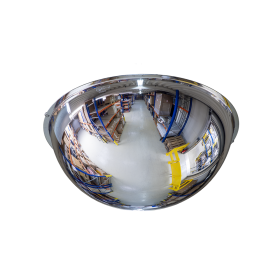
When to install a safety mirror and how to choose the right location?
The installation of a safety mirror is justified as soon as a site has a recurring blind spot: a crossing of aisles in a warehouse, a store aisle not visible from the checkout, a parking exit without visibility on the traffic lane, or a curved corridor in a building open to the public. Unlike a video surveillance camera, the mirror acts in real time and without transmission delay, which makes it an immediate prevention tool rather than a retrospective observation tool: the driver of a shopping cart or the customer of a store sees the blind spot at the very moment he approaches it. This responsiveness justifies keeping security mirrors even on sites already equipped with cameras, the two devices responding to different and complementary needs.
Which model for which use
A retail business with several high shelves will favor a dome mirror placed at central height, offering an overview from the checkout or entrance without multiplying the installation points. A logistics warehouse with perpendicular aisles will instead opt for corner mirrors positioned at each strategic intersection, particularly where carts circulate at high speed. For exterior areas such as parking entrances, loading dock exits or private road intersections, a weather-resistant model is essential, possibly with a heating system in areas subject to frost, to guarantee a reflective surface that is always clear in winter.
Implementation errors to avoid
The first error consists of positioning the mirror too low or too far back from the actual angle to be covered, which greatly reduces its useful field of vision and leaves remain an unmonitored area despite the investment made. The second error, common in warehouses, is to install a dome-shaped mirror where a 90-degree angle model would have been more relevant, or vice versa, due to failure to first check the exact geometry of the intersection to be treated. It is also not recommended to install a mirror facing a direct light source, such as a bay window or a warehouse spotlight, because stray reflections reduce the readability of the image returned during the sunniest hours of the day.
Maintenance and maintenance in operational conditions
A safety mirror quickly loses its effectiveness if it is not cleaned regularly: dust in the warehouse or outdoor projections dull the reflective surface and reduce the contrast of the image, especially in low light. Periodic cleaning with a soft cloth and a non-abrasive product is enough to maintain good reflectivity, without risking scratching the acrylic or polycarbonate dome. It is also useful to regularly check the wall fixing or the installation support, particularly on sites where vibrations linked to the passage of trolleys or vehicles can gradually loosen the anchoring points.
Integrate the mirror into an overall prevention approach
The safety mirror works best when it is part of a broader reflection on the circulation of the site: signage on the ground, marking of crossing zones and sufficient lighting reinforce its effectiveness rather than replacing it. On logistics sites, combining a polycarbonate traffic mirror at platform exit points with clear priority signage significantly reduces risky situations, much more than an isolated mirror without additional marking.