Statut en temps réel de votre commande et de votre livraison.
An advertising arch marks the entrance to a stand, a trade show or a sporting event with a visual impact that no standard roller banner or flag can match. This range is designed for event organisers, communications agencies and exhibitors who want to create a strong landmark, visible from a distance across a hall or along an outdoor route, and turn a simple passageway into a genuine gateway to their brand. It brings together inflatable structures and tubular advertising arches, in square or rounded formats, all fully customisable across their entire surface. Choosing the right model depends above all on the intended use: an indoor trade show, a sporting start/finish line, or an outdoor site entrance.
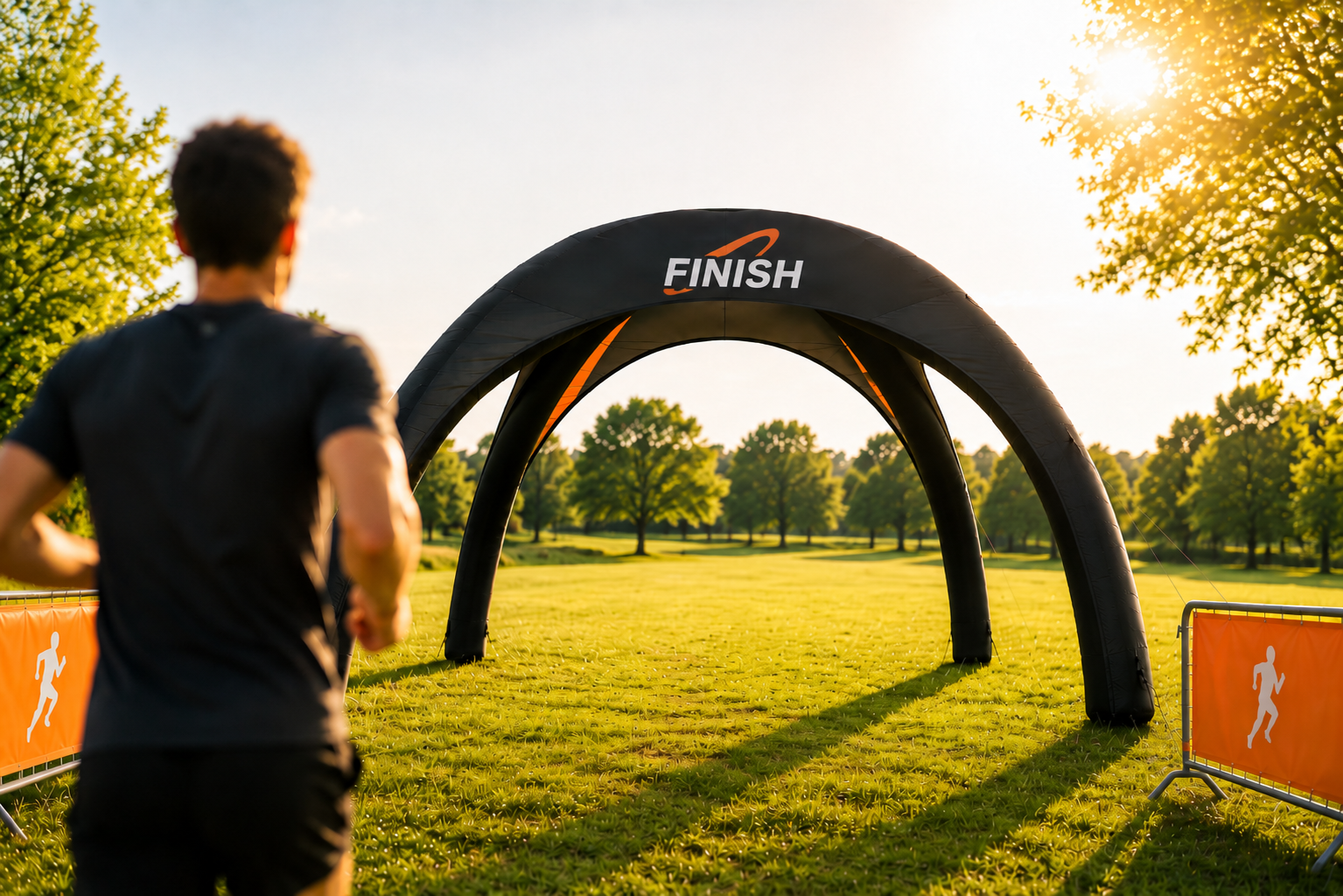
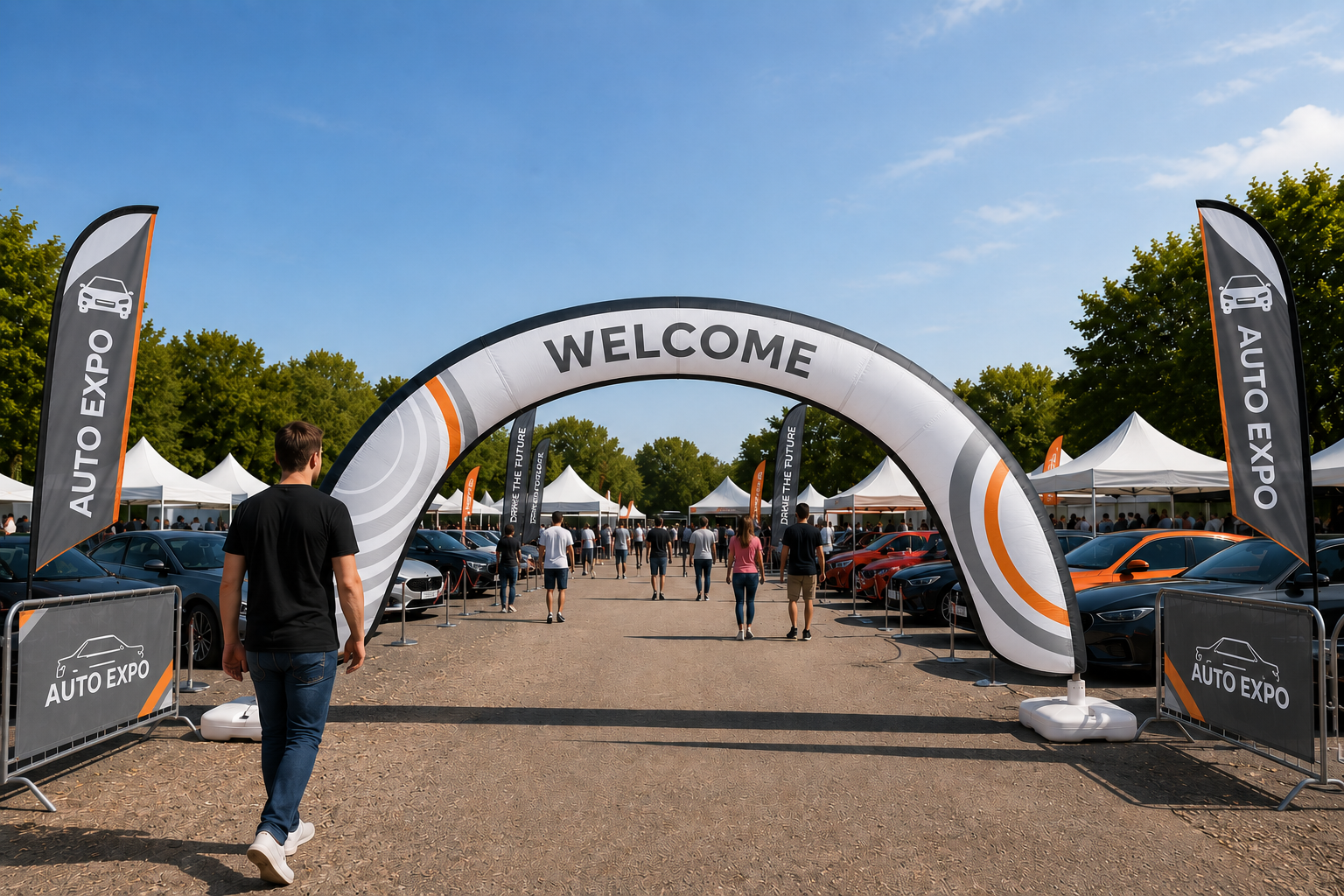
An advertising arch works just as well as a stand entrance at a B2B trade show as it does as a start or finish line for races and sporting events, where its visibility from a distance acts as a landmark for participants and spectators alike. It also accompanies openings, open days and outdoor promotional operations, where it structures the space and immediately signals the main access point.
The inflatable version stands out for its light weight and quick set-up with an electric pump, ideal for one-off outdoor events. The tubular structure, more rigid, better suits indoor stands where stability and a build-up with no electricity are priorities. Both technologies share the same requirement for full customisation across the printed surface.
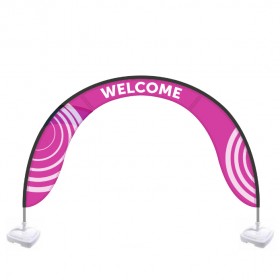
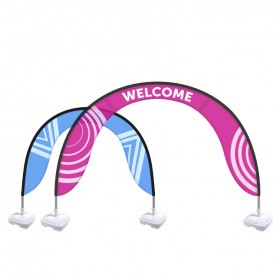
The square format offers maximum print area on the side panels and header, ideal for a highly legible brand message. The arc format, more airy, suits narrower walkways or settings where a rounded look fits better into the environment, such as a trade show aisle or a site entrance.
Every advertising arch can carry a full-colour print across its entire visible surface, logo, slogan and graphic identity included. This continuous print area makes it a far more impactful brand display than a series of separate roller banners, particularly at trade shows where the density of visual communication is very high.
Designed to be redeployed from one event to the next, these structures pack down into compact transport bags once deflated or dismantled. This portability makes it an investment that pays for itself over the year, particularly for event agencies working across several trade shows or races within the same season.
For sports events, the inflatable arch featuring sponsor logos has become the iconic visual standard: marking start lines, finish lines, and mandatory course checkpoints. Maximum visibility and lasting brand impact for sponsors.
For professional trade shows and events, an entry arch frames your main entrance or highlights a themed zone within a large venue. Pair with a fabric-covered aluminium stand backdrop and retractable barrier posts.
The choice depends on usage. The inflatable arch uses an air-filled envelope kept under constant pressure by an electric blower: maximum visual impact, spectacular rounded shapes, setup in 3 to 5 minutes, ideal as a finish line or for a one-off event. The tubular aluminium arch assembles rigid posts and a crossbar dressed with a tensioned fabric banner: a stable silhouette needing no power supply, perfect for regular or semi-permanent use. For an instant "Wow" effect at a race or grand opening, go inflatable; for a reusable arch without a blower, choose the tubular structure.
Size is defined by the passage width and clear height. For a pedestrian event entrance, a span of 4 to 6 m and 3 to 4 m of height is enough. For a race finish line letting the pack through, allow 6 to 8 m of width; XL models reach 10 m and beyond. Measure the actual space available and factor in the footprint of the inflatable feet or tubular posts, which widen the ground area. An oversized arch gains long-distance visibility but demands more ballast and standing surface, a point to confirm before ordering.
Setting up an inflatable arch is very fast: unroll the envelope, connect the electric blower, plug into 220 V mains and the arch stands up in 3 to 5 minutes. The blower keeps running throughout the event to maintain pressure and rigidity. One person is enough for standard models; two for wind-exposed XL spans. Then allow a few minutes for ballasting or ground anchoring using sandbags, stakes or base plates. Deflating and packing into the transport bag takes a similar time, making this the most mobile solution for one-off use.
Resistance depends on ballast and model. A properly anchored inflatable arch tolerates moderate wind up to around 30 to 40 km/h; beyond that, deflating is recommended to protect the envelope and public safety. The soft structure absorbs gusts by flexing, which reduces wind load. A rigid tubular aluminium arch handles sustained gusts better, provided each foot is heavily ballasted. In all cases, multiply the anchoring points (sandbags, stakes, bolted plates) and watch the weather: no event arch should stay up in high wind or a storm.
Yes, ground anchoring is essential for stability and safety. On hard ground (asphalt, slab), use sandbags or ballast bags spread across each foot, or bolted base plates where installation allows. On soft ground (lawn, soil), stakes or pegs driven through the eyelets provide the anchor. Both inflatable and tubular arches must be ballasted symmetrically to prevent tipping. The ballast weight rises with span and wind load: for large formats allow several dozen kilos per foot. Never leave an arch free-standing, even in calm weather, when the public is present.
The price depends on technology, size and customisation. A custom inflatable arch in a standard format, supplied with blower, transport bag and anchoring, falls within an accessible entry-level range for one-off event use. A tubular aluminium arch with a fabric banner represents a higher investment, justified by its durability and repeated use. Customisation by full print of your colours and logo is generally included. Pricing factors: span, number of printed faces, finish and accessories. Request a quote based on your exact dimensions for accurate costing.
Lead time depends on the technology and level of customisation. For an inflatable arch with full print, expect generally a few days to two weeks depending on artwork complexity and workshop load. A tubular aluminium arch with a sublimated fabric banner needs a comparable time, as the structure and covering are produced in parallel. Supplying a high-resolution vector file matching our templates speeds up processing and avoids proof back-and-forth. For an event with a fixed date, order ahead and flag any tight deadline so we can confirm the feasibility of an express lead time.
Can't find the answer to your question ?
An advertising arch represents a structural investment rather than a one-off purchase: it makes the most sense for organisations that return to the same type of event year after year, a recurring trade show, an annual sporting race or an open-day tour across a store network. Unlike standard stand dressing that gets renewed at every event, the arch is transported and redeployed as is, which spreads its cost across every event it's used at. The calculation is therefore less about a one-off communication spend and more about a reusable brand asset, provided its transport, maintenance and set-up at each site are properly planned.
A structure used just once a year can tolerate less careful handling than an arch redeployed across ten events in a season. For heavy use, it's better to choose a model whose transport bag and folding system are designed for repeated build-up without weakening the seams or the printed fabric. A custom outdoor arch designed for regular outdoor use is often a better long-term choice than an entry-level model redeployed too frequently.
Where the arch is placed largely determines how effective it is: positioned at the entrance to a trade show's main aisle or on the natural path of visitor flow, it catches far more attention than a placement on the periphery. For a sporting event, aligning it with the race route, with photographers or cameras nearby, multiplies the visibility of the printed message well beyond the participants physically present.
The most sensible way to budget is to weigh the cost of the arch against the number of events it will actually be used at over the year, rather than treating it as a one-off spend tied to a single show. A structure used on five or six occasions in a season easily earns back its initial cost compared with repeated hire, on top of guaranteeing an identical, recognisable brand image at every appearance.
The printed fabric of an advertising arch needs to be folded along its original creases and stored dry to avoid cracked ink and the mould that quickly appears on a tarpaulin stored damp. A clean with clear water and a soft cloth is enough between events, avoiding solvent-based products that can damage the print. Following these simple steps directly determines how long the structure stays usable across multiple seasons.
A poorly maintained arch quickly loses its premium look, working against its original purpose: embodying a flawless brand entrance. Planning its full lifecycle, from transport to storage, makes it possible to get full value from this investment across multiple successive events.
Active filters: