Statut en temps réel de votre commande et de votre livraison.
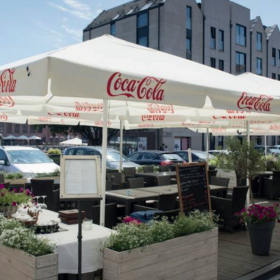
The custom parasol pairs a printed canopy in the business's colours with a structure built for intensive professional use. This range is aimed primarily at hospitality, hotel and retail operators who want to shade a terrace while displaying their brand identity at every service. The commercial parasol differs from a consumer model through the strength of its pole, the quality of its treated canopy and its ability to handle daily outdoor use across several seasons. Custom umbrellas come in several shapes and sizes to suit anything from a restaurant terrace to a lounge area or an outdoor event stand.
Positioned on a facade or terrace, a custom parasol works as a genuine advertising support, visible well beyond the area it's actually shading. The logo and colours printed on the valance or canopy panels reinforce brand recognition for passers-by and customers looking for a particular venue. This dual role of shade and communication justifies an investment that a plain, unbranded parasol simply can't offer.
The range covers several canopy shapes, from the classic square parasol to round models and offset-pole versions that free up floor space for terrace furniture. The right format depends directly on the layout of the area being shaded: a dense terrace with plenty of tables will favour an offset pole that avoids any awkward central leg, while a more open space works perfectly well with a classic central pole.
The canopy is treated to resist UV and keep its colours despite prolonged sun exposure, a specific requirement for commercial use where the parasol stays up for most of the season. This treatment limits fading of the printed graphic, a key point since the brand identity needs to stay sharp and legible for the whole life of the product.
Custom umbrellas can be branded on the canopy as well as on certain structural elements, allowing a logo, a tagline or a colour scheme specific to each venue. The print can cover the whole canopy or focus on the valance, depending on the effect wanted and how visible it needs to be from the street. This customisation fits into a broader brand consistency strategy, alongside the signage, the shop window or the terrace furniture itself.
A commercial parasol is only stable if its base is properly sized: the range includes fillable bases that provide the weight needed without the drawbacks of a solid base, which is harder to move between different terrace layouts. This flexibility is particularly useful for venues that rearrange their terrace by season or for events, since the base can be emptied to move it and refilled once the parasol is repositioned.
A restaurant terrace parasol works in demanding conditions: daily opening and closing, gusts of wind, intense sun. Our commercial models are built for the job, with water-repellent UV-treated canopies, reinforced frames and weighted bases that hold firm without drilling the ground.
The result: customers seated comfortably for longer, a terrace usable more days a year and furniture that keeps its looks season after season.
A printed branded parasol is visible from the whole street, photographed by customers and present in every story posted from the terrace. Breweries, drinks brands and retail chains use it as a partner medium: the brand provides the shade, the terrace provides the visibility.
We print your logo or full visual on every panel, with UV-resistant inks that hold their colours in the sun, summer after summer.
The size depends on the area to shade and the table layout. For a café or restaurant terrace, a square 3x3 m or rectangular 3x4 m parasol shelters four to six covers, while a round 3.5 m centre-mast model suits compact spaces. For larger terraces, cantilever parasols 4x4 m with a side arm keep the ground clear. The printed polyester canopy of each panel ranges from Ø 2 m for events up to 5 m professional, with an aluminium mast matched to the weighting of the paving slab or base.
Each canopy panel is personalised by high-definition sublimation printing: logo, slogan, Pantone colours and brand patterns spread across every gore or concentrated on alternating panels. The UV-resistant, water-repellent polyester fabric keeps vivid colours for several seasons without fading. You can also brand the surrounding printed valances, the mast band and the protective cover. Ideal for HORECA terrace branding, brewer co-branding and event activations in the colours of the establishment.
The price depends on the diameter, the structure type and the printed area. An event parasol Ø 2-3 m with an aluminium mast and sublimation print is the most affordable option, whereas a HORECA cantilever parasol 3x3 m or 4x4 m with a side arm and weighting requires a higher budget. Add the base or weighted foot, printed valances and cover. The unit price drops sharply by quantity: ordering several identical parasols for a café chain markedly optimises the cost per mast.
Allow around 3 to 4 weeks for a custom parasol - time to approve the proof, print the canopy by sublimation, then make up and assemble the aluminium structure. The lead time depends on the order volume and the artwork complexity: a batch order for several HORECA terraces needs advance planning. Non-personalised components (mast, weighted base, foot) ship faster. For an event with a fixed date, send your print files in vector format as soon as you order to secure the production schedule.
Our professional parasols are warranted against structural and stitching defects, with a duration that varies by model. Beyond the warranty, longevity depends on use: the UV-treated, water-repellent polyester fabric withstands rain and sun for several seasons, and the aluminium structure does not rust. For wind resistance, always close the parasol in gusts and use a weighted base or foot matched to the diameter. A protective cover in winter and gentle cleaning of the canopy markedly extend the lifespan on an exposed HORECA terrace.
A compact parasol covers a small table, while a larger model shelters a table for a bigger group. Choose the size according to the number of covers to protect and the size of the terrace. A rectangular or off-centre parasol can adapt its coverage to elongated spaces. The diagonal shade cast by the parasol relative to the sun affects the actual coverage, particularly at times when the sun's angle changes. The pole's height and whether it is central or off-centre also affect how functional the protected space is.
Weighted bases are the standard solution: they use weight (sand, water, concrete) to stabilise the parasol without permanent anchoring. These bases can take additional weight to strengthen their hold against the wind. For terraces on tiling or concrete, no drilling is required. For semi-permanent installations, ground-fixing systems require the owner's agreement, but weighted bases offer complete independence, ideal for hire or temporary set-ups.
Yes, provided the canopy is treated to resist UV and water, and the frame is reinforced with aluminium. The UV treatment preserves the fabric's colour and strength against prolonged sun exposure. The water-repellent finish repels rainwater, preventing pooling and rot. The right weighted base and a reinforced pole ensure stability against light to moderate winds. For permanent outdoor use, regular maintenance significantly extends the service life.
Panel printing allows for a faithful rendering of patterns and colours on each triangular section of the parasol. You can print a logo, brand identity or full visual composition. Specialists manage the adaptation to the parasol's geometric constraints (panels, pole, seams) during design. Personalisation creates immediate visual cohesion with your brand, turning the parasol into a highly visible medium from the street or neighbouring terraces, strengthening your HORECA brand identity.
Can't find the answer to your question ?
Investing in a custom commercial parasol makes sense as soon as outdoor shade becomes a recurring customer touchpoint rather than a one-off convenience: a restaurant terrace open year-round, a waiting area outside a shop, a hotel lounge or an outdoor stand used across several events. In these settings, the extra outlay over an unbranded parasol pays off through repeated brand exposure at every service, whereas a plain parasol only offers shade with nothing in return for communication. The decision comes down less to the purchase itself and more to how often it will be used and how long the venue plans to make use of the terrace or outdoor area in question.
A terrace packed with furniture will lean towards an offset pole that frees up floor space around the tables, while a more open outdoor area, such as a hotel garden or reception zone, works well with a simpler central pole. The number of parasols needed also depends on how the sun moves through the day: a terrace facing due south in the afternoon usually needs denser coverage than one naturally shaded part of the day by a neighbouring building. Planning this layout before buying avoids having to top up the setup mid-season with items that don't visually match the first parasols installed.
The stability of a commercial parasol depends first and foremost on how well its base is weighted, a point often underrated compared with the choice of canopy itself. An undersized base relative to the canopy size risks tipping in gusty wind, putting terrace customers and the parasol itself at risk. It's also worth setting aside a fixed, clear spot for each parasol, avoiding walkways where the pole or base feet could get in the way of waiting staff.
A printed canopy keeps its finish longer when folded away outside service hours and protected during extended periods of frost or heavy weather, even though the anti-UV treatment naturally limits fading in everyday use. A regular rinse with clean water, without harsh detergent, is enough to keep the printed colours sharp over time. The aluminium structure needs little upkeep beyond a periodic check of the opening and locking mechanisms, which get used daily on a busy terrace.
The first mistake is undersizing the base relative to the canopy chosen, which compromises the whole setup's stability from the very first gust of wind. The second is mixing too many formats and colours on the same terrace across successive purchases, which undermines the visual consistency the customisation was meant to achieve. Finally, overlooking sun direction and prevailing wind when choosing a spot often means repositioning parasols after the fact, when a well-thought-out layout from the start avoids the hassle entirely.
On a commercial parasol, the canopy generally wears out faster than the supporting structure, which makes a two-stage renewal more practical than replacing the whole unit at once: the structure stays in service for several seasons while the canopy is refreshed at a pace that matches its actual sun exposure. This phased approach keeps the overall cost of ownership down over time, provided a sufficiently sturdy structure is chosen from the outset to support several canopy cycles. A venue with several terrace areas therefore benefits from standardising its structures to make this partial renewal easier season after season.
Active filters: