Statut en temps réel de votre commande et de votre livraison.
A banner support structure answers a simple but technical need: keeping a printed banner taut, without creasing, sagging or risk of tearing in the wind. This range is designed for outdoor event organisers, businesses branding a shopfront or a site hoarding, and exhibitors installing a free-standing banner frame at a trade show or in a car park. It covers discreet wall-mounted structures for permanent display as well as portable free-standing frames for a short-term campaign. Every configuration is designed to keep the fabric under tension over time, an essential condition for keeping a message legible and preventing a stand banner from tearing at the first gust of wind.
Unlike a temporary frame, these support structures are sized to stay in place across several seasons on a building site, a commercial shopfront or a site fence. The treated aluminium or steel frame withstands rain, UV and temperature changes without warping, avoiding the need to re-tension the banner after every spell of bad weather. This robustness makes all the difference for site hoarding banners that need to stay crisp for the entire duration of a project.
Two installation approaches coexist within the range. Wall mounting suits shopfronts, hoardings and fences already in place, with anchor points that spread the tension evenly across the whole surface of the banner. A free-standing structure, by contrast, is installed without a wall or existing support: it proves essential on an outdoor stand, an event car park or a temporary space where there is nothing to hang the fabric from.
The sizing of the frame directly determines how well the banner holds its shape: a structure that is too small lets the fabric flap and crease, while a frame correctly matched to the format spreads the tension evenly across the surrounding eyelets. This range comes in several widths and heights to suit both standard formats and bespoke dimensions for a shopfront or a site fence.
Once the structure is in place, how well the banner holds up over time also depends on the accessories used at the surrounding eyelets. Additional tensioning accessories and reinforcement rings for the anchor points help absorb wind gusts without tearing the fabric or prematurely wearing out the eyelets.
Beyond the structure itself, the banner can be printed with the colours and message of the brand, with a UV-resistant treatment that preserves colours under prolonged exposure. This customisation turns a technical support into a genuine communication tool for a project or an event, visible from the road or a trade show aisle.
For permanent installations (large-format signage, corporate building communication), galvanized steel wall structures ensure lasting fixture for 10-15 years with minimal maintenance.
For events, weighted pedestal supports (water or sand fillable) that set up in minutes without tools. Quick breakdown and repacking between events.
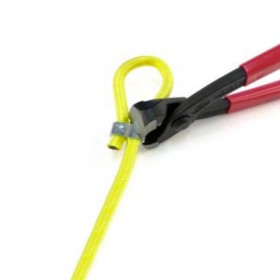
The choice depends on the available surface and how long the banner stays up. Wall-mounted frames in aluminium or galvanised steel bolt directly onto a facade or cladding: the banner is tensioned between two horizontal profiles, ideal for a permanent sign. Weighted freestanding stands, self-supporting with a water- or sand-fillable base, suit events and spots without a load-bearing wall. Banner tensioning via eyelets and elastic bungee cords keeps the surface flat without flapping in the wind, both indoors and outdoors depending on your location.
For a 3x2 m banner, choose a frame whose clear opening slightly exceeds the banner dimensions so the tensioning via bungee cords works. A tubular frame of about 3.10 x 2.10 m in aluminium or galvanised steel leaves room for the perimeter eyelets (spaced 30 to 50 cm) and the elastics. Order your banner with a welded hem and reinforced eyelets every 50 cm. On a weighted stand, the base must stabilise a 6 m² wind load; in the wall version, fixing points every 50 to 60 cm ensure lasting flatness with no creases or sagging.
Yes, provided you pair a properly sized structure with a mesh banner. A large solid banner acts like a sail: on a freestanding stand, ballast the base with water or concrete slabs according to the exposed surface. On a facade, wall structures in galvanised steel take sustained gusts thanks to anchors matched to the substrate. To cut the wind load, choose a mesh banner that lets air through, and tension it firmly with bungees: a well-tensioned banner flaps less, wears more slowly and keeps its flatness across several seasons.
It depends on the model and height. Weighted freestanding stands are assembled tool-free by one person: slot the tubes, fix the banner with eyelets and bungees, fill the base. No professional needed. Wall structures at height, however, require drilling with anchors matched to the substrate (concrete, brick, cladding) and compliance with safety rules: above 3 m or on a facade over a public way, call in an installer. We supply an assembly guide and the fixings; the equipment stays demountable and reusable for repeated campaigns.
Yes. Beyond standard formats, we produce made-to-measure structures in aluminium or galvanised steel matched to the exact surface of your facade or location. The high-definition printed banner carries your brand identity (logo, Pantone colours, artwork), with reinforced eyelets positioned to suit your frame. You choose the profile colour, the finish (raw, lacquered, powder-coated for outdoors) and wall or freestanding fixing. The banner stays interchangeable: you refresh your seasonal message while keeping the same load-bearing structure.
Lead time depends on the configuration. A standard frame alone (aluminium or galvanised steel tubes, fixing accessories) usually ships within 5 to 10 working days subject to stock. When the order includes a custom printed banner, add file approval and production time: high-definition printing on PVC, welding the hems and setting the eyelets take a few extra days. Made-to-measure structures require a longer manufacturing lead time. Approve your proof and measurements early to secure a delivery aligned with your installation date.
The structures carry a commercial warranty covering manufacturing defects. Beyond that, durability comes down to the material: aluminium does not rust and galvanised steel resists corrosion for many years in permanent outdoor use. The load-bearing structure outlasts the banner by far: a UV-treated PVC banner holds on average 2 to 5 years before fading. Stainless steel fixings and reinforced eyelets extend service life. To maximise durability, periodically check the tension of the bungee cords and the tightness of the wall fixings.
Can't find the answer to your question ?
Choosing between a wall-mounted structure and a free-standing frame for a banner support structure depends mainly on how often it will be used and whether a solid fixing point is available on site. A shopfront, a site fence or an existing load-bearing wall naturally points towards wall mounting, cheaper to install and more stable over time since it relies on a structure already anchored to the ground. Conversely, an outdoor event, a temporary car park or a space with no available wall calls for a free-standing structure, more versatile but requiring suitable ballast or ground anchoring to stay stable. Between the two, the deciding factor remains the planned length of use: display over several months justifies a premium structure in treated aluminium, while an operation lasting a few days can make do with a lighter frame, reusable across several successive campaigns. A structure that is undersized for the site's actual use often has to be revisited after a single season, which costs more in the long run than a more robust initial choice.
A correctly sized banner support structure is reused across several campaigns or seasons, which completely changes the economics compared with disposable display. The structure accounts for most of the initial investment, but only the printed banner needs replacing from one campaign to the next. On a long-term project, investing in a robust structure from the outset avoids the repeated reinstallation costs that an undersized, temporary support would bring, having to be replaced several times over.
Periodic inspection of the fixing points and eyelets is generally enough to preserve the tension of an outdoor banner support structure. Checking the fixings after periods of strong wind, cleaning the structure to prevent oxidation at contact points, and quickly replacing a worn eyelet or tensioning accessory significantly extend the service life of the whole system. Neglecting this maintenance accelerates wear on the banner itself, which ends up tearing at the anchor points long before the structure does.
While the structure itself lasts several years with no major intervention, the printed banner wears out faster under the combined effect of sun, wind and handling during campaign changes. Planning this replacement in advance, as soon as colours start to fade or an eyelet shows signs of wear, avoids using a damaged fabric that eventually tears under tension and damages the structure meant to protect it. This distinction between a long-lasting structure and a consumable fabric helps spread the investment in an outdoor display project over several years rather than renewing everything at once.
Several mistakes crop up repeatedly on building sites and at events, undermining how well the structure holds up:
Anticipating these points at the selection stage avoids costly corrective work once the structure is in place, and ensures a banner support that stays functional for the whole duration of the campaign or project.
Active filters: