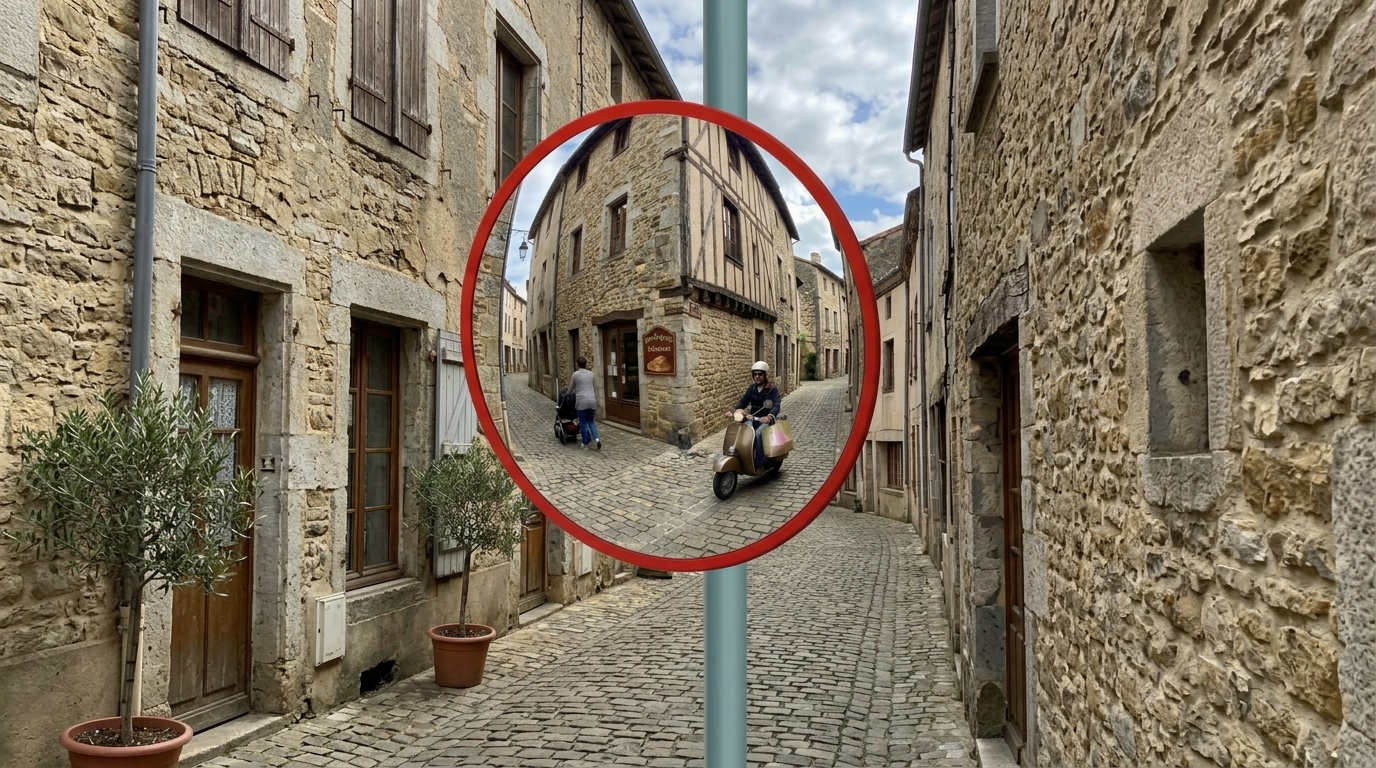
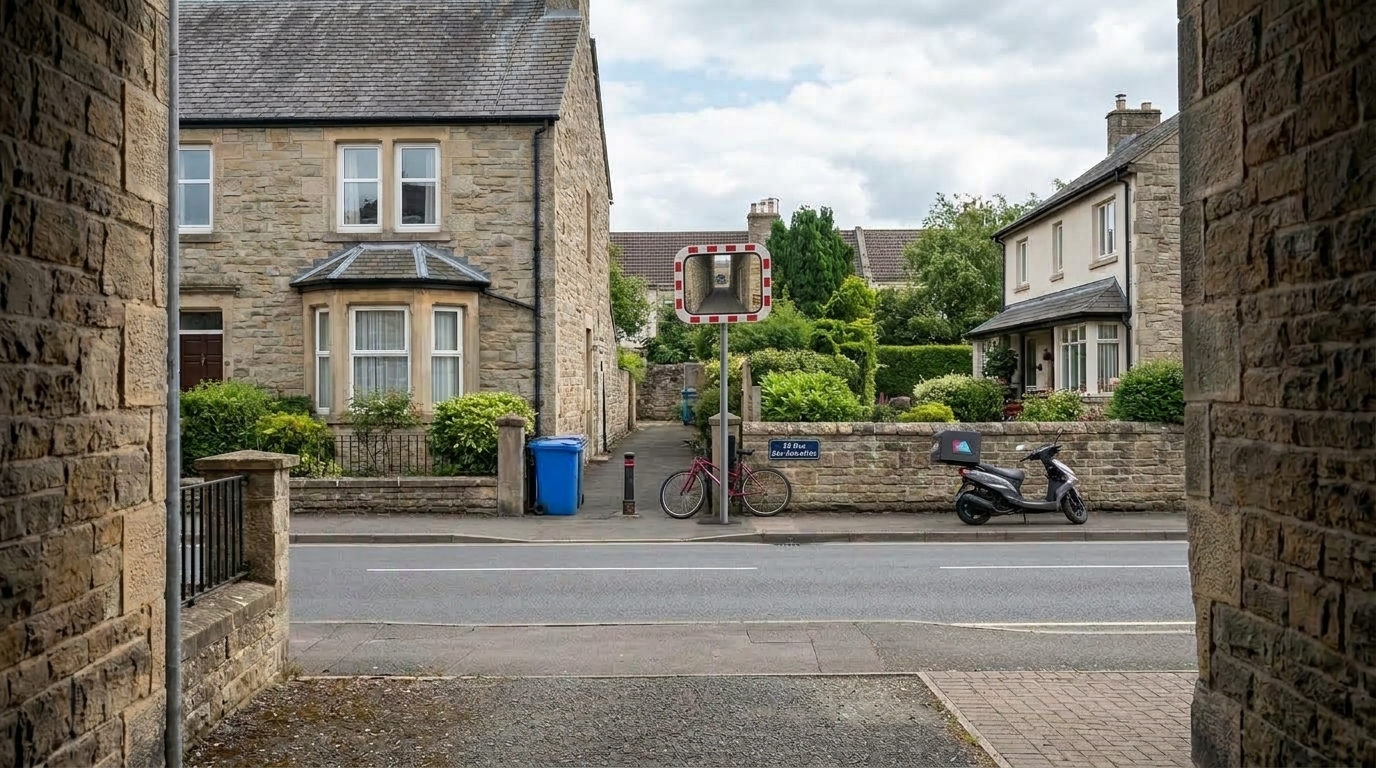
A road mirror is justified as soon as a traffic point combines a blind spot and a flow of vehicles or pedestrians: exit from an underground car park, crossing of aisles in a warehouse, sharp turn in a logistics yard, opening onto a poorly cleared private road. Investing in this passive safety device costs infinitely less than a collision between two vehicles or a collision with a pedestrian, and its installation remains quick compared to road redevelopment. Logistics site managers, communities, co-ownerships and car park operators use it primarily in areas where speed and direct visibility cannot be reconciled otherwise. The intersection mirror then completes existing traffic signage without requiring heavy work or prolonged traffic interruptions.
Properly position a road mirror on the ground
The effectiveness of a road mirror depends almost entirely on its location. It should be oriented to cover the entire risk area from the actual position of the driver or forklift operator, usually with a slight downward tilt angle to encompass the nearby roadway as much as the escape point. The installation height is calculated by taking into account both the line of sight from a vehicle and the clearance required for pedestrians and handling equipment. On a logistics site, a full-scale test with a moving trolley allows the angle to be validated before final fixing.
Wall, pole or surface-mounted fixation
Depending on the configuration of the site, the mirror is fixed to a facade, to an existing lighting mast or to a dedicated surface-mounted structure. An adjustable arm facilitates subsequent adjustments if traffic changes, for example during a change in warehouse organization. On the axes exposed to shocks, a reinforced fixing limits the risk of accidental misalignment caused by a vehicle or handling equipment brushing against the structure.
Maintenance and durability outdoors
A road mirror remains outdoors all year round and is exposed to UV, rain, spray or frost depending on the region. Regular cleaning of the reflective surface maintains a clear result, an essential condition for its safety function. In areas subject to frost and condensation, a heated version prevents the formation of fogging or frost which would make the mirror unusable at the most critical times, typically early in the morning in winter.
Errors which reduce the effectiveness of a road mirror
Complete passive safety in risk areas
On certain sites, a road mirror benefits from being supplemented by ground markings or slowdown signs upstream of the point blind, to accustom drivers to anticipate the area before even seeing the reflection. This combined approach reduces the reaction time required, particularly in warehouses where multiple traffic flows intersect near a loading dock. However, it remains secondary: the mirror remains the main tool to cover a blind spot that no signage alone can make visible.
A poor choice of installation neutralizes the investment even with a quality mirror. The most common errors in the field:
- An installation height unsuitable for the size of the vehicles or pedestrians on the site
- An angle not verified from the actual position of the driver before fixing
- Vegetation or an obstacle which gradually obscures the field of vision
- The absence of a heated version in an area regularly exposed to frost
For complex intersections or areas exposed to bad weather, the heated version polycarbonate unbreakable like the reflective polycarbonate traffic mirror resists impacts better than a glass mirror, while the heated safety mirror remains the most reliable solution as soon as frost sets in for a long time.