Statut en temps réel de votre commande et de votre livraison.
Suspended signage encompasses communication and display solutions mounted from the ceiling rather than floor or walls: overhead signs for aisle and zone identification, hanging poster frames for aerial communication, supports for event banners. Stand-Direct offers a complete range: suspended signs for permanent identification, hanging poster frames for flexible communication.
Suspended overhead signage delivers multiple strategic benefits: visibility from distance above crowds (essential in large spaces like shopping centres, exhibition halls, trade shows), floor space liberation for circulation and furniture placement, zone orientation and identification in expansive areas (retail aisles, thematic zones at events, service identification in public halls), maximum visual impact through bird's-eye viewing effect.
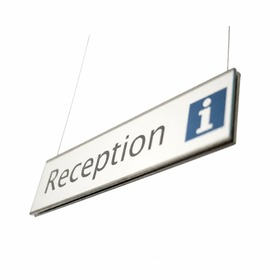
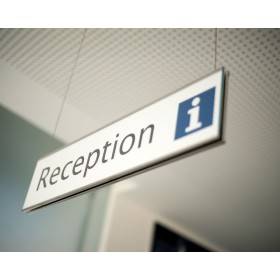
Suspended signs durably identify specific zones: retail aisles (groceries, beauty, fashion, sports), hospital services (radiology, cardiology, emergency), shopping centre counters (information, reception, security). Durable materials (powder-coated aluminium, plexiglas), high-definition engraving or printing, aerial fastening via cables or rigid rods. Lifespan 10-15 years in normal indoor use.
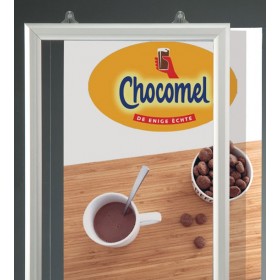
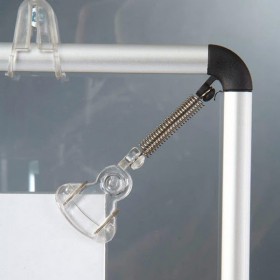
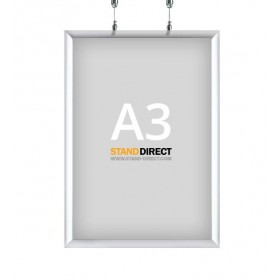
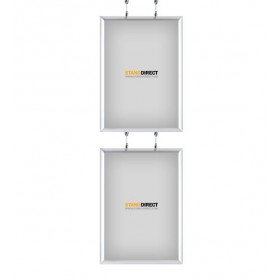
Hanging poster frames enable renewable overhead communication: click-clack frames for suspension, profiles with wall and ceiling mounting, cable tension systems with adjustable fasteners. Ideal for temporary event communications (renewed promotional campaigns monthly, thematic exhibitions, event hall installations) where update flexibility is essential.
Overhead installation requires secure fastening suited to ceiling support: hooks on standard drop ceilings, direct attachment to concrete ceilings, fasteners on technical rails (T-bar). Fastening dimensioning must account for suspended element weight (typically 1-5 kg for standard signs, up to 15-20 kg for large signs) with 30-50% safety margin. For special installations, consult a professional.
Suspended signage is part of our complete indoor display range. For specific hanging frames, consult our dedicated category. For other wall display supports, see our click-clack frames and display frames. Delivery within 7-12 working days to BENELUX and Western Europe.
In supermarkets, hypermarkets and shopping centers, suspended signs are the central signage element that structures customer orientation. Each department or thematic area is identified by an overhead sign visible from a distance (food, beauty, fashion, sport, toys, etc.).
For a coherent deployment in a department store, it is essential to harmonize the format, material and finish of the signs on all the departments. This visual uniformity facilitates immediate understanding by customers and considerably professionalizes the store's image. Complete with complementary interior signage at the main orientation levels (store entrance, general plans) and secondary (shelving, gondola ends).
At large-scale trade shows and thematic exhibitions, suspended elements visually structure the different areas of the show and guide the visitor's journey: thematic banners suspended above each area, identification signs for the main aisles, sponsor suspensions for events supported by partners.
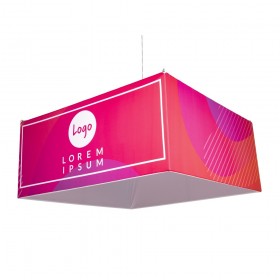
For individual exhibition stands, personalized suspended elements (hanging kakemonos, banners at your charter) indicate your stand from the end of the main aisle. Combine with a tubular stand background to your charter, rollups and strap guide posts for a coherent and impactful event system on several visual levels.
The suspended elements allow you to enhance your signage and your visual communication by exploiting the full display height available in your interior spaces. Suspended from the ceiling, above a stand, in a central aisle or at the heart of a point of sale, they immediately catch the eye from afar and facilitate the orientation of your visitors in busy areas.
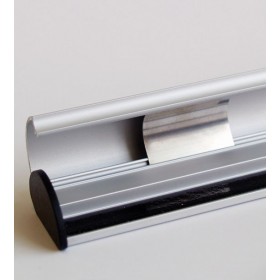
Particularly appreciated by retailers, department stores, trade show organizers and supermarkets, these overhead supports include poster hangers, fixing rails, textile frames and custom-made suspended signs. Their lightweight aluminum design combined with adjustable cable systems guarantees secure hanging, smooth visual rendering and rapid replacement of your posters and tarpaulins throughout your promotional campaigns.
Find below all the answers to your questions about the choice of ceiling fixing systems, compatible formats, the weight of the structures and the installation of your suspended elements.
The installation height depends on use. For a large-area department identification sign, allow 2.5 to 3.5 meters from the ground (above customers' heads while remaining legible). For event banners in a high-ceilinged hall, 3 to 5 meters for maximum visual impact without obstructing traffic. For standard corridor signs, minimum 2.30 meters for comfortable free passage for taller people.
It mainly depends on the ceiling support. On standard false ceiling (mineral tiles), allow 2-5 kg maximum per fixing point. On concrete ceiling with reinforced metal dowels, up to 20-30 kg per point. On exposed technical structure (T-bar rails, beams), weight sized according to the structure (generally 10-50 kg). For heavy or special installations, be accompanied by a suspended installation professional who will guarantee the security of the fixing.
For a large-area department identification sign, the optimal format is 60-80 cm high by 100-200 cm wide depending on the length of the department to be identified. For small specialized departments, 40 cm in height may be sufficient. For very large areas or main departments, up to 100-120 cm in height for visibility from the entrance to the store. Clear typography in capital letters, strong contrasts (often white on a colored background identifying the product family).
Yes, all our suspended elements are customizable: digital printing or screen printing for signs, laser engraving for metal parts, Pantone powder coating for structures, sublimation printing for textile banners. Allow 10-15 business days for production for common customizations. For large store brands with premium finishes (deep engraving, relief lettering), 3-6 weeks depending on complexity.
It depends on weight and complexity. For small lightweight elements (textile banners, lightweight panels weighing less than 5 kg) on standard false ceilings, installation is accessible to your technical team with clear installation instructions. For heavier elements or specific fixings (reinforced concrete ceiling, exposed technical structure, significant height), be accompanied by a suspended installation professional who correctly sizes the fixings and guarantees safety.
A professional hanging sign has a lifespan of 10 to 15 years in normal indoor use. The aluminum structure does not alter, the printing retains its colors (slight discoloration possible after 8-10 years in a bright environment), the fixings remain stable. For hanging textile banners, lifespan of 5-8 years depending on use. The periodic renewal of signs generally corresponds to changes in the graphic charter or commercial positioning of the store.
For hanging signs with personalization to your charter, allow 10-15 working days of production after validation of the graphic proof for standard orders. For large premium brands with deep engraving or relief lettering, 3-6 weeks. For multi-site deployments (complete equipment for a chain, national store fleet), dedicated logistics planning with our salespeople and significant decreasing rates.
Yes, it is even strongly recommended for a complete visitor orientation. Suspended signs provide the main orientation visible from afar (identification of large areas), while wall signage provides local details (identification of shelving, sub-services). This multi-level strategy (hanging for macro-orientation + wall-mounted for micro-orientation) is the standard approach for modern department stores and public establishments.
Can't find the answer to your question ?
The suspended elements are often under-exploited by businesses and establishments which systematically favor floor or wall signage. However, in certain contexts, aerial communication is by far the most effective for orientation and identification.
First use case: large open spaces (shopping center halls, exhibition halls, train stations, airports). Floor or wall signage is lost in the ambient visual noise; the suspended signage dominates and remains visible from the end of the space, considerably facilitating visitor orientation.
Second use case: large area ray identification. A sign suspended above each department (food, beauty, fashion, etc.) allows the customer to instantly locate the desired department from any point in the store. This overhead signage has become standard in modern mass distribution, and its absence is immediately noticeable as a defect.
Third use case: thematic events and exhibitions. Hanging banners or signs above each thematic area of a show or exhibition naturally guides the visitor in their journey and visually structures the space. Particularly effective for very large multi-thematic shows.
Fourth use case: liberation of floor space. In places with high traffic or restricted circulation spaces, suspending communication frees up the floor for pedestrian traffic and essential furniture. Particularly valuable in narrow corridors, in front of busy reception desks, or in architectural spaces to be enhanced.
For aerial fixings, safety takes precedence over everything: systematically use fixings sized for 30-50% above the actual weight to be supported. A falling sign or banner can seriously injure you and incur your civil liability. For special installations or heavy elements (more than 10 kg), be accompanied by a suspended installation professional.
Active filters: