Active filters:
Statut en temps réel de votre commande et de votre livraison.
The parking wheel stop physically marks the limit of a parking space and stops a vehicle pulling in too far, protecting facades, dock structures and neighbouring vehicles from repeated knocks during manoeuvres. This range suits businesses, warehouses, logistics platforms and company car parks that need to secure parking areas used daily by cars or by lorries making trickier manoeuvres. The right model depends directly on the size of the vehicles using the space, the type of surface and the level of traffic the area needs to handle.
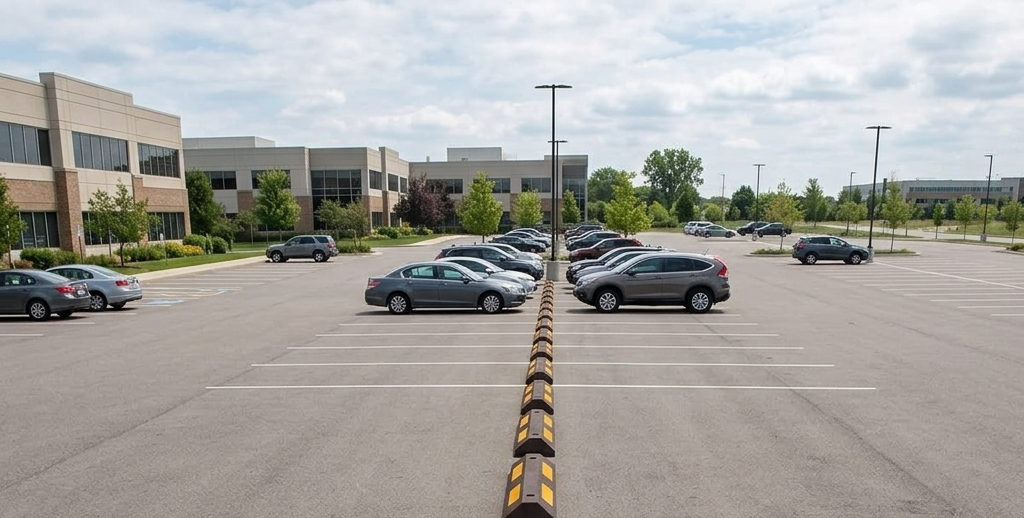
In an office or retail car park, a 90 cm wheel stop is generally enough to stop a car before it reaches a wall, a fence or a neighbouring space, while also clearly marking the limit of each bay for drivers.
Loading and manoeuvring areas for lorries need a heavier-duty size: a 100 cm heavy goods vehicle wheel stop withstands far greater weights and manoeuvring speeds than a car, which calls for larger dimensions and fixings sized accordingly.
Reinforced concrete and recycled rubber are the two most common material families for this type of equipment: concrete offers substantial weight and stability for high traffic areas, while rubber absorbs repeated impacts better and reduces tyre wear on frequently used spaces.
A wheel stop only does its job if it's properly fixed to the ground: anchoring with bolts or base plates stops it moving on impact, whereas a model simply set down risks sliding and losing its effectiveness after the very first collision.
Good visibility of the wheel stop cuts the risk of an accidental knock, particularly at night or in low light: strong colour contrast between the wheel stop and the ground surface helps drivers spot the limit of their manoeuvre before they even reach it.
On a logistics platform, wheel stops are often combined with loading docks to secure the exact position of a lorry during handling operations. Precise positioning stops a lorry reversing too far during unloading, protecting the dock, the warehouse door and the handling equipment used close to the vehicle.
Bolted to the ground, our parking wheel stops outline every bay and halt the vehicle exactly where it should park. Made of recycled rubber or concrete, with reflective strips and fast bolt-down install, they structure your parking spaces for years.
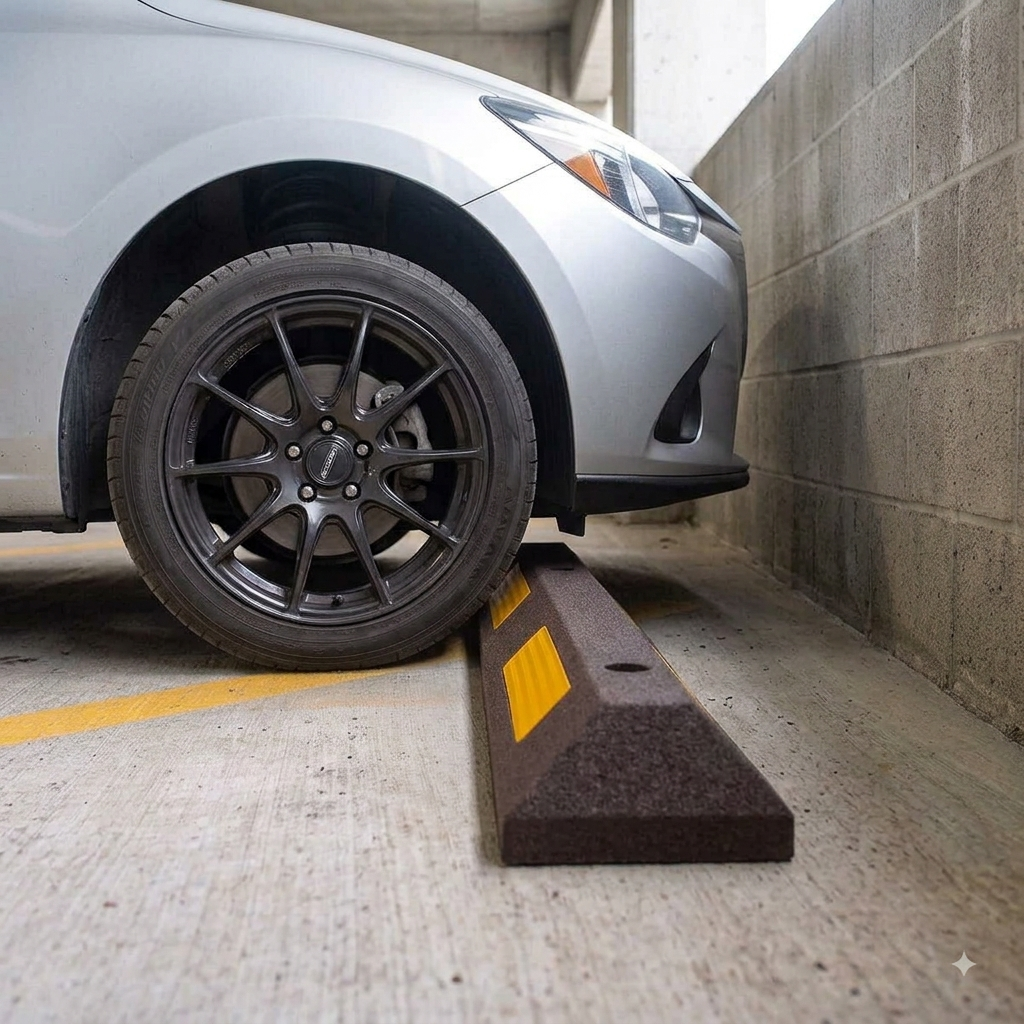
In underground car parks or at loading docks, our wheel stops halt the vehicle before impact and protect walls, bollards and equipment. Rugged and highly visible, they prevent bodywork damage and safeguard the building structure over the long term.
Our range covers two main formats. The short wheel stop of around 55 cm secures a single wheel and is the most cost-effective way to delimit an individual bay. The full-length parking kerb of 1.8 m spans the entire width of a space and stops both wheels of the vehicle. Expect a height of 10 to 15 cm and a width of 12 to 15 cm, dimensions calibrated to block a tyre without catching low bumpers. Recycled rubber is also available in a low-profile version for accessible bays and mixed pedestrian zones, while heavier concrete units suit high-traffic fleet car parks.
Yes. Beyond standard black, recycled rubber is available in yellow, white or red to flag sensitive areas or reserved bays. Integrated reflective strips sharply improve visibility at night and in poorly lit underground car parks, a key safety advantage. On concrete units, painted markings or bay numbers can be applied for clear parking bay delimitation and fleet management. We also offer consistent colour codes to distinguish visitor, staff and service vehicles, helping you organise a corporate car park while keeping wayfinding intuitive for every driver entering the site.
Price depends mainly on material and length. A short recycled rubber wheel stop is the most affordable option, ideal for equipping many bays on a tight budget. A full-length 1.8 m kerb or a concrete version is a higher investment but delivers greater mass and resistance to heavy goods vehicles. Options such as reflective strips, colour or fixing bolts also affect the figure. On volume, the unit cost drops sharply, so request a quantity quote to equip a complete car park at the best direct manufacturer price. Recycled rubber also saves on installation thanks to its lighter weight.
For standard recycled rubber models, short or full length, the usual lead time is around 2 weeks with stock available. Concrete units, being heavier, may require slightly longer due to palletised transport and reinforced packaging. Orders with customisation (specific colour, marking, bespoke reflective strips) generally add a few production days. For a complete car park fit-out, we recommend ordering ahead to coordinate delivery with the installation schedule, allowing time for bolt or dowel fixing on site. We confirm a firm delivery date as soon as the quote is approved.
Our wheel stops are designed for intensive outdoor use and offer a service life of 10 to 15 years under normal conditions. Recycled rubber resists UV, frost, hydrocarbons and repeated tyre impacts without cracking the way concrete can under freeze-thaw cycles. Longevity depends heavily on installation quality: bolt or dowel fixing into a concrete or asphalt base ensures stability and prevents the unit from shifting under vehicle impact. The commercial warranty covers manufacturing defects, and following the installation guidelines preserves its validity, protecting your investment across the whole car park.
Can't find the answer to your question ?
Deciding to fit a car park or manoeuvring area with wheel stops is rarely an aesthetic choice: it's a direct response to a history of knocks against facades, metal structures or neighbouring vehicles, or a way of getting ahead of that risk when designing a new site. The cost of a parking wheel stop is nothing compared with repairing damaged cladding, a wall or a collision between two vehicles, which makes the investment particularly worthwhile as soon as a site sees more than a handful of manoeuvres a day. The hard part isn't deciding to invest, it's choosing the right model for the right use, a point often underestimated when buying.
A common mistake is fitting an entire car park with the same wheel stop model, without distinguishing areas used by cars from those used by lorries. A size built for a car doesn't effectively stop a lorry making a slow manoeuvre, exposing the protected structure to exactly the impact the wheel stop was meant to prevent. Conversely, systematically oversizing an entire car park adds unnecessary cost in areas reserved for cars, where a more compact model does the job just as well.
How well the unit is fixed to the ground directly determines how effective it is against impact: on asphalt, chemical or mechanical anchors suited to that surface guarantee a lasting hold, while a concrete slab generally allows a simpler, stronger anchor. Installing a wheel stop without adequate anchoring, relying solely on its own weight to hold it in place, risks the unit gradually shifting with repeated impacts, until it no longer does its job properly.
Reinforced concrete holds up very well over time against weather and UV, but can chip locally after repeated heavy impacts, which is why the most heavily used areas are worth inspecting periodically. Recycled rubber keeps its integrity better against repeated knocks but is more sensitive to prolonged sun exposure, which can gradually harden it and reduce its shock-absorbing capacity. Choosing between the two materials depends as much on how often impacts are expected as on the site's climate and exposure.
Beyond the choice of model, the exact position of the wheel stop relative to the facade or obstacle being protected determines how effective it really is: positioned too far away, it leaves a residual gap that still lets a vehicle reach the sensitive area; positioned too close, it can damage the bumper during a normal manoeuvre. Spacing that matches the actual size of the vehicles using the site, checked on the ground rather than estimated from a plan, remains the best way to avoid both pitfalls and guarantee lasting protection for the infrastructure.
On a site where cars and lorries cross paths, it's better to clearly mark out separate zones rather than install an intermediate size meant to suit every vehicle. This approach avoids compromises that end up under-protecting lorry areas while unnecessarily oversizing spaces reserved for cars, and makes traffic rules immediately clear to both regular and occasional drivers on site.
Active filters: