Statut en temps réel de votre commande et de votre livraison.
Outdoor banners and hanging signs structure vertical communication in exterior environments: aluminium or stretched textile structures, heights 2-3m, ideal for outdoor retail displays, event entrances, long-distance signage. Stand-Direct offers a range adapted to permanent outdoor conditions.
See also outdoor display and promotional wind flags. Delivery 2-3 weeks.
The advertising banner is made for messages that need to carry far: seasonal promotions, a new store opening, sports sponsorship or event signage. Mounted on eyelets or a tension frame, it dresses a facade, a site hoarding or a fence while staying easy to read, even in strong wind.
Our frames fit most existing structures and take interchangeable banners: change your message without changing the frame.
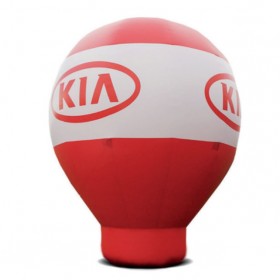
When visibility at ground level is no longer enough, aerial signage takes over. A giant advertising balloon can be spotted from several hundred metres away and guides visitors to your stand, your activation or your open-air point of sale.
Combined with outdoor banners and advertising sails, it creates a complete display that catches the eye at every height. A particularly effective solution for festivals, fairs, outdoor exhibitions and open days.
Our outdoor kakémonos come in standard widths of 60, 85 and 100 cm at heights of 2 to 3 m, with beach-flag models reaching 4-5 m. The printed textile is tensioned over an aluminium or fibreglass tubular structure, available in teardrop, sail or feather shapes depending on the wind exposure required. For large-format banners, dimensions range from 80 x 200 cm up to 100 x 300 cm. A custom format is always possible to suit a specific location, a façade or an event entrance, single- or double-sided according to the visibility you need.
Yes, every outdoor kakémono is fully customisable through digital printing. The artwork is printed using sublimation or solvent on coated polyester textile, delivering vivid, UV-stable colours even in full sun. You supply a vector or high-resolution file (300 dpi), and we faithfully reproduce your brand guidelines, logos, photos and full-bleed backgrounds right to the edge. A double-sided print with a blockout interlayer ensures perfect readability on both faces. The printed flag can be ordered separately from the structure, letting you refresh a campaign while keeping the existing pole and base.
The price of an outdoor kakémono depends on the artwork size, the type of structure and the base you choose. A complete beach-flag kit (fibreglass pole, printed textile and base) typically starts around €60 to €90 excl. VAT in size S and rises to €120 to €200 excl. VAT for L and XL double-sided formats. Cost mainly varies with the base type selected: economical ground spike, weighted cross base, water tank or wall plate. Volume discounts apply from several units, ideal for lining up a series of flags along an event entrance. The replacement print alone remains the most economical option.
The lead time for a custom outdoor kakémono depends on printing the artwork and sourcing the structure. For a standard kit (pole, printed textile and base), allow roughly 5 to 10 working days after proof approval. Large-format aluminium structures or batch orders of beach-flags may require 10 to 15 working days. File approval is the key step: a compliant artwork (300 dpi, full bleed, colour profile) speeds production considerably. For an event on a fixed date, build in a comfortable margin and flag any deadline so we can adjust manufacturing priority and the shipping method accordingly.
Our outdoor kakémonos are built to withstand the weather over time. The printed textile in coated polyester is UV-treated to limit fading, and the aluminium or fibreglass tubular structure tolerates extended outdoor use. With a suitable base (weighted cross, water tank or ground spike), the assembly handles moderate wind; in strong wind or a forecast storm, it is advisable to take the flag down to protect the pole. The warranty covers manufacturing defects. The real-world lifespan of the artwork in permanent outdoor use is commonly around one to two seasons depending on exposure.
A hanging banner is a vertical display suspended by cables or a pole, showing a visual on both sides. A banner is more compact, fixed to a shopfront or fence. An advertising sail (or advertising balloon) creates an imposing three-dimensional presence, highly visible from a distance. Each suits different contexts: the hanging banner for a lasting shopfront presence, the banner for limited spaces, the sail for maximum event impact.
High-density PVC tarpaulins offer excellent UV resistance thanks to their built-in anti-fade treatments. They withstand rain, wind and sunlight without deteriorating prematurely. Adding a protective varnish improves durability in tropical or coastal outdoor settings. Anodised aluminium frame profiles complete this protection, preventing rust and corrosion.
Yes, most professional structures feature interchangeable tarpaulins. Only the printed tarpaulin needs replacing, allowing the visual message to be updated with each campaign or season. This modularity considerably reduces renewal costs and makes it easy to adapt quickly to new promotional needs.
Fixings are usually made with clamps, hooks or elastic tensioners, providing a solid hold against vibration and wind. For a shopfront, quality wall plugs suited to the material (brick, concrete, metal) ensure safety. On a fence, diagonal cable tensioning systems offer optimal stability. A load calculation beforehand is recommended for particularly windy areas.
Can't find the answer to your question ?
The choice between an outdoor roller banner, a pop-up banner or an advertising sail depends above all on the layout of the site and its exposure to wind, far more than simple aesthetic preference. A standard roller banner works perfectly on a sheltered shopfront or a low-exposure shop entrance, while a completely open site, roadside or in a car park, exposes the structure to gusts that can knock it over if it isn't properly weighted. Understanding this placement logic before buying avoids ending up with a display that looks great on paper but is unusable in practice at the intended site.
For a shopfront or a building entrance, a standard advertising banner remains the simplest solution to set up and the most legible from the street. On a more open site, such as a car park, an event area or the entrance to an outdoor trade show, a triangular advertising sail offers better wind resistance thanks to its shaped design, which lets some air pass through instead of presenting a solid surface. For a one-off event where the main goal is to catch the eye from a distance, an advertising balloon inflated overhead effectively complements a set of ground-level roller banners.
The stability of an outdoor display rests almost entirely on its weighting system, whether that's a water-filled base, a concrete plinth or sandbags matched to the weight of the structure. Underestimating this at the point of purchase is the most common mistake: an outdoor roller banner that's correctly printed and well positioned, but under-weighted, regularly ends up blown over after just a few hours of wind exposure, which damages the fabric and forces an early replacement.
A display left outdoors continuously builds up dust, pollen and rain marks that gradually dull the colours. A regular clean with clear water and a soft cloth, with no abrasive product, is enough to keep the message legible over time. It's also worth periodically checking the condition of the eyelets and fixing systems, which wear out faster outdoors than indoors.
Combining a roller banner, an advertising sail and an advertising balloon on the same event site can quickly create visual clutter if each display carries a different message. The clearest setup is one where a single main message is carried across all the displays, with a clear hierarchy between the landmark visible from afar, such as the balloon, and the detailed information available up close, such as the roller banner.
On a very busy route, several displays of different sizes positioned in a row create a progressive landmark effect that's far more effective than a single large isolated display. Conversely, on a low-visibility site, it's better to concentrate the budget on a single large display rather than spreading the spend across several small formats that lose individual impact. This site-specific placement logic should take priority over the choice of model itself.
An outdoor display rarely stays up for a whole season without the message needing to change, whether that's a new offer, a range change or a one-off promotion. Choosing a fixing system from the start that lets you easily swap the printed fabric, without redoing the whole supporting structure, avoids replacing the entire display every time the message is updated and reduces the overall cost of ownership across several successive campaigns.
Active filters: