Active filters:
Statut en temps réel de votre commande et de votre livraison.
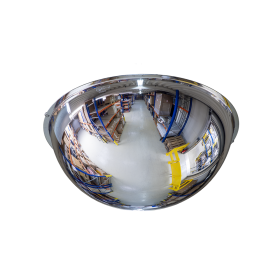
The observation mirror equips shops, warehouses, car parks and circulation areas that need to cover a blind spot or a sales floor that's hard to watch from a single till point. Mounted up high, it reflects a wide view of the space and lets staff keep constant visual control without having to move around. This solution suits retailers, supermarkets, logistics warehouses and any public-facing site laid out across several zones or aisles. Depending on the layout, a dome-shaped observation mirror gives a 360 degree view from a central point, while a corner model focuses on a specific nook or the junction of two aisles.
Mounted on the ceiling at the centre of a sales floor, the dome mirror offers a panoramic view of the surrounding aisles from a single point. This format works particularly well for large retail floors, warehouses and storage areas where one observation point needs to cover as much ground as possible. Its spherical shape slightly distorts the image at the edges but takes in a far wider field of view than a standard flat mirror.
The 90 degree corner model sits at the junction of two aisles or at the entrance to a section hidden from direct view by shelving or a partition. It helps staff anticipate people crossing paths or keep watch over a specific corner without having to add equipment across the whole floor. This format usefully complements a set of dome mirrors by covering the areas a panoramic view can't reach.
The diameter of the mirror directly determines the size of the area covered and the distance at which it stays legible for staff at the till or on the move. A small sales floor is generally well served by a compact size, while a warehouse or large retail space needs a bigger diameter to stay effective over distance.
The store observation mirror can be ceiling mounted for a bird's eye view over a circulation area, or wall mounted at the corner of an aisle to cover a specific junction. The choice of mounting point depends on the available ceiling height and the actual angle to be covered, two things worth checking before installation to guarantee a genuinely useful image.
Beyond tackling shrinkage, the observation mirror also helps keep circulation routes safe in a warehouse, anticipate a forklift or staff member crossing a path in a storage area, or cover a blind corner in a car park. This dual role, protecting stock and protecting people, makes it a fixture in far broader settings than retail alone.
Shrinkage concentrates in the areas staff cannot see. A well-placed anti-theft mirror changes the game twice over: it lets you watch the hidden aisle from the till, and its mere presence tells an ill-intentioned visitor they can be seen at any moment.
Alongside cameras, a shop surveillance mirror gives real-time vision with no screen to check: the shopkeeper's eye takes in the whole store.
The choice depends on the area to cover. A 360° dome on the ceiling watches an aisle junction in every direction; a 90° corner mirror fits a wall angle and links two perpendicular aisles; a classic convex wall mirror covers a straight line or an entrance.
In a medium-sized shop, two or three well-positioned mirrors are usually enough to eliminate every blind spot along the customer journey.
The choice depends on the area to be monitored and the angle required. Round convex mirrors in acrylic (diameter 30 to 80 cm) cover a radius from the till, 90° models fit into a wall corner, 180° models at the end of an aisle and 360° domes at the centre of the shop for panoramic surveillance. The larger the diameter, the greater the usable viewing distance: allow roughly 5 m for a Ø50 cm and up to 12 m for a Ø80 cm. Rectangular mirrors suit long corridors, while small discreet till mirrors monitor the checkout area.
Observation mirrors are standardised products, but their installation is fully customisable. The choice of angle (90°, 180°, 360°), diameter and mounting bracket (adjustable wall bracket, articulated arm, ceiling suspension for domes) lets you adapt each mirror to your layout. A convex acrylic mirror sits discreetly in a corner or above the till to cover blind spots without disrupting the flow. For brand identity, some shops add a frame surround, but the reflective surface stays neutral to ensure sharp, faithful anti-theft observation across the sales floor.
The price depends on type, diameter and material. A small discreet till mirror starts around 25-40 €, a convex acrylic mirror Ø50 cm with wall bracket sits between 50 and 90 €, and a large-diameter 360° dome for panoramic surveillance exceeds 150 €. Acrylic offers the best price-to-strength ratio for anti-theft surveillance: lighter and shatterproof compared with glass. The overall cost stays low against the reduction in shrinkage: a single theft prevented in a covered aisle often pays back the purchase. Volume discounts from several units to equip a whole shop.
Standard convex mirrors (90°, 180°, 360° domes) and till mirrors are common products, usually shipped within 1 to 2 weeks. Lightweight acrylic models pack and travel easily, which shortens lead times compared with fragile glass mirrors. For large diameters or domes intended for panoramic shop surveillance, allow a few extra days depending on stock. The mounting bracket (adjustable arm, wall plate) is supplied with the mirror, allowing immediate installation on arrival, with no wait for additional parts.
Our mirrors come with a manufacturer's warranty covering material and manufacturing defects, typically 1 to 2 years. Beyond that, real-world durability is excellent: the reflective surface in shatterproof acrylic does not tarnish and withstands everyday knocks in store, unlike glass which can break. In indoor use at a till point or in an aisle corner, a convex surveillance mirror keeps a sharp image for many years. The mounting bracket and adjustable arm, in treated metal, stay stable and re-adjustable over time, ensuring reliable and long-lasting anti-theft observation.
The choice depends on the geometry of the area and the type of coverage required. A 360° dome offers complete panoramic visibility, ideal for open junctions or central thoroughfares. A 90° corner mirror covers two perpendicular directions, perfect for corners or intersections. A discreet wall-mounted convex mirror suits stockrooms or back areas. An effective strategy often combines several formats for complete coverage without visually overloading the shop.
The observation mirror creates an immediate psychological deterrent: any customer or person with bad intentions sees their reflection and understands that the area is being watched. This visible presence significantly reduces attempts at theft or product tampering. Staff can also react quickly in the event of suspicion, thanks to increased visibility over blind spots. Combined with vigilant stock management, the mirror represents a long-lasting investment in preventing commercial losses.
The number of mirrors depends on the floor area, the shop layout and the at-risk areas (tills, stockroom, blind spots). A small shop may need 2 to 3 strategically positioned mirrors. A medium-sized shop benefits from 4 to 6 mirrors combining domes and 90° corners. Stand-Direct recommends a tailored audit to define the optimal strategy based on the layout and customer flow of each shop.
The security mirror complements rather than replaces a CCTV system. It offers real-time observation with no recording or IT maintenance costs, covers blind spots not seen by cameras, and creates an immediate visible deterrent. The mirror does not offer the legal evidential capabilities of cameras in the event of a serious incident. A multi-layered approach combining mirrors, cameras and prevention staff is the best anti-loss strategy for a shop.
Can't find the answer to your question ?
Choosing an observation mirror suited to your sales floor starts with pinpointing the actual blind spots from the till or reception desk, rather than fitting mirrors at random across the whole shop. A small shop with an open layout can often make do with a single central dome mirror, while a floor split across several aisles or levels usually needs a combination of dome mirrors for overall coverage and corner mirrors for specific blind spots. Investing in a quality store observation mirror pays off through its lifespan, an unbreakable polycarbonate unit installed correctly stays functional for many years with minimal upkeep, unlike CCTV solutions that come with a subscription and ongoing technical maintenance.
A local shop with a central till and one or two aisles will usually opt for a single 360 degree dome observation mirror, positioned to cover the whole floor from the till. A larger floor, split into aisles or with corners created by display units, benefits from combining this central model with one or more corner observation mirrors placed at strategic junctions. A warehouse or storage area calls for larger diameters, since the viewing distance is typically greater than in a standard retail setting.
Mounting height and angle determine how effective the mirror really is. Positioned too low, it narrows the field of view and exposes the mirror to knocks from handling equipment; positioned too high or poorly angled, it leaves a residual blind spot that staff don't immediately notice. It's worth testing visibility from the main observation point, till or security desk, before fixing the unit permanently, and adjusting the angle once installed to cover the area identified as sensitive.
The observation mirror needs very little upkeep, a regular wipe of the reflective surface is enough to keep the image sharp. Unbreakable polycarbonate models withstand accidental knocks from trolleys or handling equipment, a real benefit in a warehouse or stockroom where the risk of impact is higher than on the shop floor. Wall or ceiling fixings should be checked periodically to make sure they stay secure over time, particularly in settings exposed to regular vibration.
An observation mirror doesn't replace a CCTV camera but usefully complements one, particularly in areas where recorded footage adds nothing over an instant, direct view for staff on duty. Unlike a camera, it needs no power supply, no software maintenance and no recording management, which considerably simplifies installation and long-term running costs. Many retailers combine both, with the mirror covering immediate blind corners and the camera recording the most sensitive areas of the sales floor.
Active filters: