Statut en temps réel de votre commande et de votre livraison.
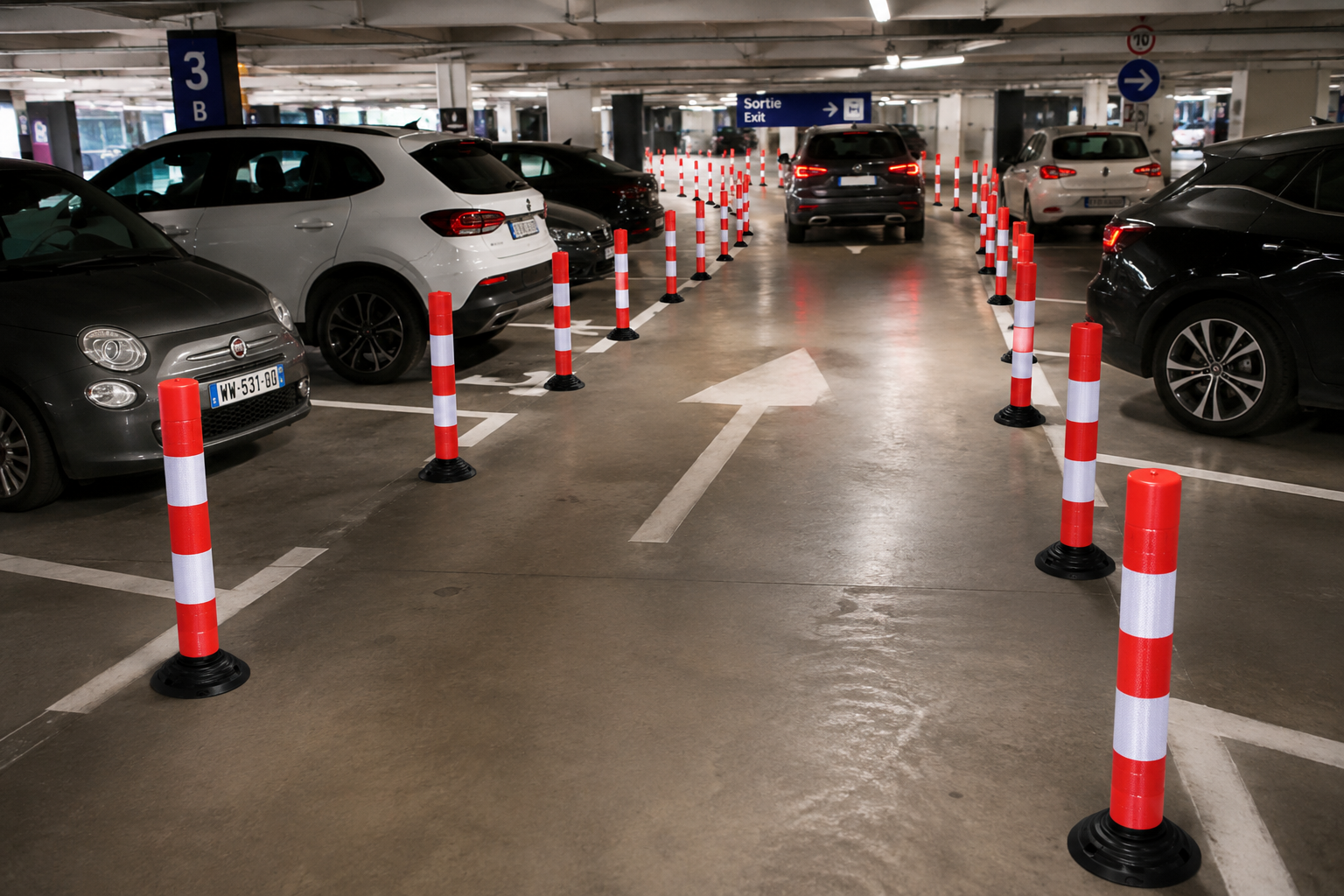
The flexible bollard and the delineator mark out a traffic or safety zone on sites where repeated impacts would render rigid street furniture unusable within weeks. This range is designed for warehouse operators, car park managers, logistics sites and temporary building sites that need to mark out an aisle, a pedestrian crossing or a restricted zone without installing a fixed structure that is costly to repair. Thanks to its flexible base, the unit bends under the impact of a forklift, a vehicle or a distracted pedestrian, then automatically returns to its upright position, with no cracking or permanent deformation. This resistance to repeated impacts makes it a durable alternative to rigid kerbing at every exposed traffic point.
The body of the delineator is made from a flexible material that absorbs the energy of an impact rather than transmitting it to a rigid fixing point. After an impact, even one that happens several times a day, as is common in a warehouse, the structure returns to vertical by itself with no manual intervention. This feature significantly cuts maintenance compared with a rigid bollard, which cracks or deforms permanently after the very first impacts.
The heights available across the range cover both low-level marking of a pedestrian aisle and more prominent marking of a vehicle traffic zone. A greater height improves visibility for forklift drivers and motorists, particularly at manoeuvring angles where attention rarely settles at ground level.
A bolted ground fixing suits permanent traffic zones, such as a warehouse aisle or a protected car park crossing, offering maximum stability against side impacts. A weighted or removable base, on the other hand, suits configurations that change regularly, such as a temporary building site or a traffic zone that shifts with logistics operations.
Reflective bands built into the body of the delineator ensure visibility at night and in low light, a critical point in vehicle traffic zones in warehouses or outdoor car parks. Orange and black finishes serve different purposes: orange prioritises maximum visibility in a hazard area, while black blends more discreetly into existing indoor signage.
In a car park, the reflective orange flexible delineator clearly marks out areas where parking is prohibited. In a warehouse, the reflective black flexible delineator discreetly marks out forklift traffic aisles without adding to an already visually busy environment with bright colours.
In a car park, a petrol station or a logistics hub, the flexible delineator post guides vehicle flows without creating a dangerous obstacle: entrances and exits, traffic direction, lane separation, protection of islands and technical equipment.
Installation is quick: each bollard bolts to the ground through its base plate with a few anchors, and can be replaced individually when worn, without redoing the whole layout.
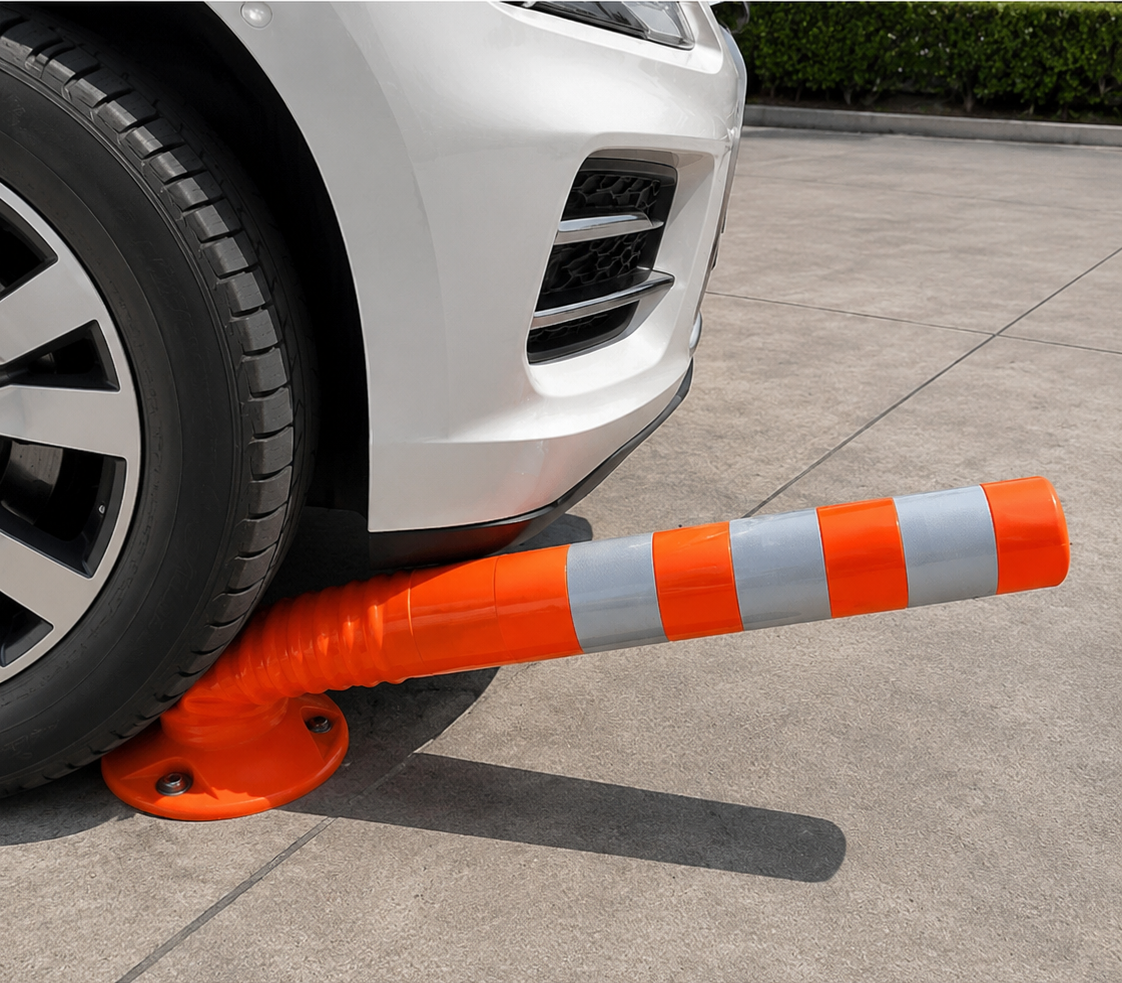
Shape-memory polyurethane is what makes this equipment so valuable: crushed under a car or lorry wheel, the flexible bollard springs back upright, intact. No more broken elements to replace after every misjudged manoeuvre.
That flexibility also protects vehicles: no deep scratches or torn-off bumpers, an argument appreciated in public car parks and tight delivery areas.
Our flexible bollards come in several standard heights: 450 mm for ground-level marking, 750 mm and 1000 mm for lane channelling, and up to 1150 mm for maximum visibility in car parks. The soft TPU/polyurethane body measures 80 to 100 mm in diameter and mounts on a surface-fixed base plate secured with anchor bolts. Slimmer delineators (50-80 mm) suit the demarcation of parking rows and traffic lanes. Every model carries one or two high-intensity reflective bands so it stays clearly visible to drivers at night.
Yes. The TPU/polyurethane body comes in several through-coloured shades: safety yellow, red, white, orange or black, letting you visually code your traffic lanes and no-go zones. The reflective bands (class 2) are available in white, red/white or yellow to suit local regulations. On request we apply custom marking (bay number, pictogram, logo) using adhesive film or hard-wearing screen printing. This customisation sharpens the legibility of your signage without compromising the self-recovering flexibility of the material after impact.
A flexible bollard is a modest investment compared with the damage it prevents. Pricing depends on the height, the diameter of the TPU/polyurethane body and the number of reflective bands. Unlike a rigid post, it bends on impact then springs back to shape: no damaged bodywork, no replacement after every knock, which keeps running costs very low. For car parks and industrial sites, volume discounts apply from just a few units. Request a precise quote based on your chosen models and quantities to optimise your signage budget and benefit from the best direct-supplier rates.
Standard flexible bollards and delineators (yellow, red, white with reflective bands) typically ship within 1 to 2 weeks. Common TPU/polyurethane models with a surface-mount base are held in stock, which speeds up order processing for car parks and pedestrian zones. For customisation (specific shade, logo marking, bay number), allow 2 to 3 weeks depending on volume. On large rollouts we stagger shipments to match your site schedule, so installation crews are never left waiting. Confirm your quantities and finishes to receive a firm delivery date and plan your lane-marking project with confidence.
Our flexible bollards come with a manufacturer warranty and a long service life thanks to the self-recovering TPU/polyurethane: after an impact the body springs back to its original shape without cracking or breaking, where a rigid post would deform permanently. The material is UV-treated to withstand sun, frost and weather without yellowing. The reflective bands keep their night-time visibility for years. In car-park or lane-delineation duty, these bollards absorb hundreds of vehicle impacts with no maintenance and no replacement, while leaving bodywork undamaged, delivering an excellent return on investment.
The flexible bollard absorbs the impact of wheels without damaging vehicles, unlike rigid models which can cause scratches or bumper damage. On a company car park or delivery area, flexibility also reduces the risk of accidents and driver frustration. What's more, the flexible delineator returns to its original shape after each pass, extending its useful lifespan.
Fixing with a bolted base plate is the standard method: fixing holes are drilled into the ground, then the delineator's base is bolted down. This installation requires no grouting or adhesive, which speeds up the fitting process. Replacement takes just a few minutes, unscrewing the bolts and fitting the new bollard. This modularity is ideal for areas requiring frequent maintenance.
Yes, the polyurethane formulation used by Stand-Direct is optimised to withstand thousands of passes without permanent deformation. Its shape memory allows it to straighten up again every time after being driven over. This behaviour makes it particularly suited to high-traffic car parks, service stations and event areas.
The built-in reflective strips capture light from headlights or ambient lighting and send it back towards the source. This optical property works regardless of the weather and remains effective even in rain or fog. The delineator thus becomes a passive marker that guides traffic without relying on a power supply.
Can't find the answer to your question ?
The choice between a flexible bollard and a rigid kerb or bollard essentially comes down to how often the protected zone is expected to be hit. As soon as a traffic point faces regular scraping or impacts, whether from forklift manoeuvres in a warehouse, vehicles cutting a corner in a car park, or building site machinery operating close by, the flexibility of the unit completely changes the economics. A rigid bollard cracks or works loose after a few impacts and needs replacing, whereas a flexible model absorbs the impact and keeps working with no intervention needed. In low-impact-risk areas, on the other hand, a conventional fixed unit remains a sensible choice and avoids over-investing in a technical solution whose flexibility would never be called upon.
The effectiveness of a line of delineators depends as much on the spacing between units as on the model chosen. Spacing that is too wide lets a vehicle pass between two units without touching them, cancelling out the intended deterrent effect, while spacing that is too tight unnecessarily increases the number of units and the installation cost. On a warehouse traffic aisle, positioning delineators slightly back from manoeuvring corners prevents them from being struck systematically during tight forklift turns, extending their useful service life even under flexible-duty conditions.
The type of ground directly determines the fixing method used. A concrete slab in good condition accepts a standard bolted fixing, the most stable option for intensive use. On a thinner asphalt surface, a fragile industrial floor covering or an area where the fixing should not be permanent, a weighted or removable base avoids damaging the ground while still offering good resistance to side impacts. Checking the nature of the surface before choosing the fixing method avoids the base coming loose prematurely, the most common cause of early replacement.
The flexible material forming the body of the delineator remains exposed to UV, to hydrocarbons in a logistics environment, and to abrasion from repeated impacts. A periodic visual check helps spot the start of cracking or a loss of elasticity before it compromises the unit's ability to spring back upright after an impact. Regular cleaning of the reflective bands also keeps them effective at night, a point that is often overlooked despite directly affecting safety in a vehicle traffic zone.
Several mistakes crop up repeatedly when installing flexible delineators at a logistics site or car park:
Planning ahead, with consistent spacing and a fixing method suited to the ground, ensures a flexible delineator that stays effective over time without multiple replacements caused by wear or poorly anticipated impacts.
Active filters: