Active filters:
Statut en temps réel de votre commande et de votre livraison.
Car park barriers control and restrict access to parking areas reserved for businesses, shops, residential blocks and logistics sites. This range is aimed at managers of private car parks, security managers at industrial sites, and residential property managers who want to reserve spaces for occupants or authorised visitors. Each solution combines mechanical strength with everyday ease of use, for controlled access without constant staff supervision. It answers both a one-off need during building work and a permanent installation on an operational site.
This equipment protects spaces reserved in front of a shop, secures the entrance to a company car park or marks out a manoeuvring area on an industrial site. Residential blocks use it frequently to prevent unauthorised parking on private spaces, while logistics sites use it to organise heavy goods vehicle movement. On temporary building sites, quick installation secures an access point without major civil engineering work.
The folding car park barrier is operated manually with a simple arm movement to open or close the passage, ideal for use several times a day. The retractable post, more discreet, folds flat to the ground when not in use and effectively protects a single reserved space. Other chain or strap systems suit wide passages where occasional closure is enough. The choice of mechanism depends directly on how often it is opened and the size of the vehicles involved.
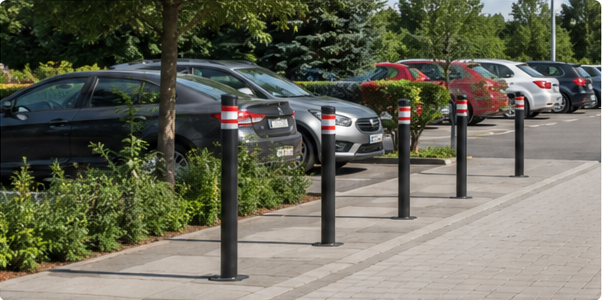
Most structures are made from galvanised then powder-coated steel, a treatment that resists corrosion over the long term even in permanent outdoor use. Epoxy paint finishes help colours hold up against UV exposure and repeated contact from vehicles. Some models include reflective strips to stay visible at night or in low light, an important point for access points used in the evening.
Mechanical strength relies on ground anchoring via a bolted baseplate or an integrated sleeve, providing resistance to impact and attempted forcing. A careful installation takes into account the type of surface, asphalt, concrete or paving, and the exact width of the passage being secured. Enough clearance must be allowed for the barrier's swing when in the open position.
A padlock or a key system reserved for authorised users restricts use to those entitled to it, an essential point for named spaces. The colour of the structure and the addition of ground marking or a numbered plate make it easier to quickly identify each reserved space. This customisation also strengthens visual consistency with the site's existing signage.
Our range covers several formats for every parking need. The folding parking post with lock and key is the most popular solution for private parking reservation: tilted to the ground it frees the spot, raised and locked it blocks it. We also supply fixed posts to set in concrete, removable posts on a base plate, manual lifting barriers and steel parking hoops in galvanized finish. Common heights from 50 to 100 cm, with reflective bands for night-time visibility on private car parks.
Yes, several levels of customization are available. On folding parking posts you choose the colour (red/white, yellow, raw galvanized), the height and the locking system: keyed-alike lock and key for a fleet or an individual padlock. We add reflective bands, a 'Reserved space' marking or your logo by screen printing, and adapt the ground fixing (bolt-down base plate or set in concrete). For company car parks, master keys simplify the management of several reserved spots from a single set.
Price depends on the type and finish. A folding parking post with lock and key to reserve a spot starts at entry level, while a reinforced galvanized steel model with a high-security padlock and reflective bands sits higher. Manual lifting barriers and ground-set hoops vary by length and fixing method. For B2B orders we apply volume discounts: equipping a full company car park noticeably lowers the unit cost compared with a single private parking reservation post. Request a quote for a firm net price tailored to your project.
Standard folding parking posts and galvanized steel hoops are kept in stock and usually ship within a few working days. For manual lifting barriers or large quantities intended to equip a full company car park, allow on average 2 to 3 weeks. Customized versions (a 'Reserved space' marking, keyed-alike lock, or a special colour) require extra manufacturing time. We confirm the exact delivery date as soon as the quote is approved, so you can schedule the ground fixing and on-site installation of every private parking reservation post.
Our barriers and posts come with a commercial warranty, but their real strength is outdoor durability. Hot-dip galvanized steel resists corrosion, rain and frost for years with no maintenance. On folding parking posts, the hinge mechanism and the lock and key are built for repeated opening cycles, and the padlock can be replaced if needed. Correct ground fixing (set in concrete or a bolt-down base plate) ensures the post withstands impacts and forcing attempts on a reserved private parking spot, keeping the reservation reliable over time.
Can't find the answer to your question ?
Investing in a car park barrier is worthwhile as soon as protecting a space or an access point causes a recurring problem: unauthorised parking, unauthorised vehicles, or poorly managed flow between heavy goods vehicles and light vehicles. The real benefit shows up less in the installation itself than in the management time avoided, fewer neighbour disputes, and a more professional image for visitors to a site. A structure correctly sized from the outset avoids the hassle of later modification, particularly when the passage needs widening to accommodate a van or a heavy goods vehicle. Before choosing a model, it is worth assessing how often it will be opened each day, how many people will be authorised to operate it, and the level of resistance needed against a deliberate attempt to force it.
Occasional use, such as closing off a company car park overnight, is well served by a simple chain or strap system stretched between two fixed anchor points. Intensive daily use, with several dozen operations a day, calls for a robust folding barrier whose hinges can withstand repeated wear without developing play. For a single space reserved for an employee or a valued customer, a retractable post remains the most discreet and quickest solution to operate.
Passage width should be measured against the widest vehicle expected to use it, including manoeuvring clearance, to avoid bodywork scrapes in wet weather or low visibility. The ground anchor should be positioned clear of any frost zone or buried pipework, information to check before any drilling. On soft or gravel ground, a wider fixing plate or an additional concrete base ensures the whole installation holds up over time.
The lifespan of an outdoor structure mainly depends on the quality of its anti-corrosion treatment and how often the moving joints are lubricated. Regularly checking welds, hinges and the locking system helps spot wear before it compromises the security of the access point. Periodic cleaning of the structure, particularly by the coast or in salty environments, limits rust forming at the fixing points.
Beyond the initial installation, keeping a car park barrier in service over time means preventive maintenance, occasional replacement of consumables such as keys or padlocks, and possibly a repaint after several years of outdoor exposure. An undersized model from the outset creates far more upkeep down the line, between early replacement and managing disputes linked to poorly controlled access. Planning for this upkeep when selecting a model makes it possible to compare solutions on how well they hold up over time rather than on first impressions alone.
Many sites undersize the usable passage width, forcing the later replacement of equipment that is still relatively new. Others overlook how many keys or fobs need to be distributed, leading to repeated back-and-forth to open an access point that was not properly planned for. Finally, anchoring carried out without a prior ground survey leaves the structure exposed to premature loosening from repeated impacts.
Active filters: