Statut en temps réel de votre commande et de votre livraison.
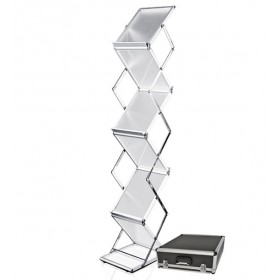
The portable brochure holder answers a very practical need for sales and marketing teams: being able to display A4 documents, flyers or catalogues at any point of contact, without relying on fixed furniture. Built as a folding display stand, it opens up in seconds at a trade show, a reception counter, a pop-up stand or a temporary retail space, then folds flat to go back in its carry bag. This range suits companies that regularly take part in events, field sales teams and retail outlets that change location often. It solves the familiar problem of the disposable cardboard display or the fixed easel that's too rigid to move around regularly. Every model combines light weight, ground stability and enough storage capacity to cover a range of brochures or product sheets.
Unlike a standard counter display, the portable brochure holder is designed from the outset to be moved from site to site. Its frame folds flat or packs into a dedicated carry bag, so it slips into a car boot or checks in as luggage on a business trip. Sales reps and network managers use it to stock a pop-up outlet, a shopping arcade or a partner showroom without ordering new furniture for every visit. This portability makes it a regular tool for teams covering several sites a month.
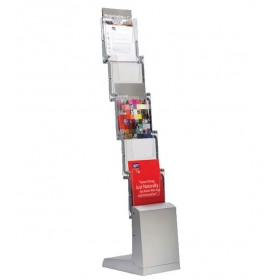
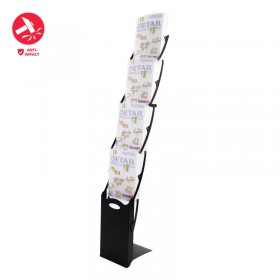
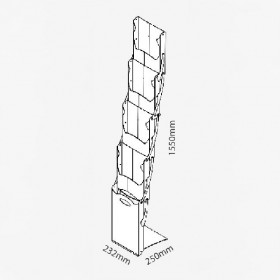
Most references in the range are sized for A4 documents, whether a single copy or several stacked together depending on pocket depth. Some models offer several compartments side by side to display different brochures or a product range at once, while others favour a single large sloped panel for a generous stack of one document. The number of pockets you need depends directly on how many items you want to make available to the public at the same time.
Frames are usually aluminium or rigid PVC, materials chosen for being light without sacrificing stability once the stand is unfolded. Black or white finishes fit easily with existing branding and blend in with most stands and counters already in place. This understated finish means the brochure holder can be paired with complementary graphics, such as a roller banner or reception desk, without a visual clash.
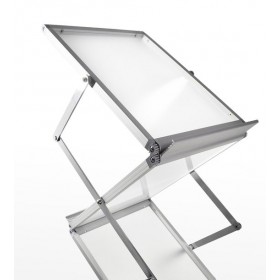
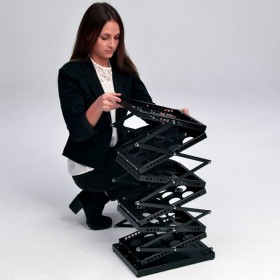
Setup needs no tools or technical skill: the frame unfolds and locks into position in a few steps, letting one person put the stand up in minutes before a show or event opens. The carry bag supplied with most models protects the frame in transit and makes it easy to store between uses.
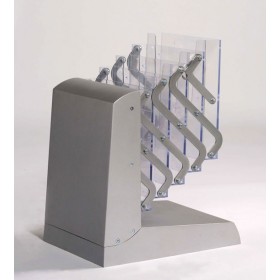
Choosing between a compact counter version and a larger floor version depends on the space available at the point of sale and the volume of literature to display. A black version with a carry bag suits reps travelling frequently, while a folding brochure counter suits teams looking for a more stable presence on a fixed stand over several days. The folding brochure counter offers a larger display surface for multi-day trade shows.
For mobile sales reps working multi-city routes, a portable brochure holder brings professional structure to every client meeting. Pair with a rollup for complete visual communication at client locations.
For multi-location event organizers (training sessions, conferences, regional trade shows), portable brochure holders deploy in minutes at each venue and pack away just as quickly between events.
A folded portable brochure stand in aluminium typically weighs between 4 and 8 kg, transport bag included, making it easy for a single person to handle without a trolley. Lightweight telescopic-pole models drop to 4-5 kg, while rigid multi-pocket A4 versions reach 7-8 kg. This low mass means you can load it into the boot of an ordinary car and move it around a trade show or retail floor without effort. The reduced weight remains the decisive argument for mobile sales reps who run several itinerant appointments in a single day.
Depending on the model, a portable brochure stand offers 4 to 12 A4 pockets spread over several tiers, giving a combined capacity of 200 to 600 standard brochures. Soft-display versions accept A4, A5 or DL formats interchangeably thanks to adjustable pockets, while multi-sided structures double the number of visible documents on the same footprint. For a busy trade-show stand, opt for 8 to 10 pockets to avoid running out of stock during peak attendance. This modular capacity covers product literature and event catalogues alike, adapting to each campaign.
Setting up a portable brochure stand takes just 1 to 2 minutes for a single person, with no tools required. The principle is intuitive: unfold the aluminium structure, clip the telescopic poles into place, then slot in the displays or A4 pockets. No screws or keys are involved. This tool-free assembly is decisive for sales reps arriving at a trade show with a tight set-up window, and dismantling is just as fast when the event ends. The structure then packs straight back into its carry bag, ready for the next travelling presentation.
Yes, almost all our portable brochure stands ship with a reinforced carry bag included, tailored to fit the folded structure. This tough nylon bag protects the aluminium profiles and displays from knocks and dust in transit, and some premium references even offer a version with telescopic wheels that eases movement through a station or across long exhibition halls. Reinforced handles and a shoulder strap make carrying comfortable. This packaging turns the brochure stand into a genuine mobile tool, ready to chain together travelling events without premature wear on the components.
Folded into its bag, a lightweight portable brochure stand usually fits within the dimensions of cabin or checked luggage, depending on the model. The most compact versions, with telescopic poles and soft displays, pack down into a sleeve of around 70-80 cm, compatible with most scheduled-airline holds. For a business trip by air, always check the model's exact packed size and your carrier's baggage allowance. Bulkier multi-pocket A4 structures travel better in the hold.
Yes, the portable brochure stand can be customised depending on the range: a high-definition printed topper panel with your logo, textile cladding of the uprights in your brand colours, or a visual integrated above the A4 pockets. Customisation by HD printing turns the structure into a genuine brand carrier visible from a distance on a stand. The displays stay neutral and interchangeable, so the same base serves different campaigns by swapping only the printed graphic, reinforcing brand recall at every trade show.
The price of a portable brochure stand varies with the structure and number of pockets: expect around 60-120 € for a lightweight model with soft displays, and 150-350 € for an aluminium multi-pocket A4 structure with wheeled bag. The price generally includes the reinforced carry bag, a valuable item often sold separately elsewhere. Printed customisation of the topper is a modest extra. Given its durability, tool-free assembly and reuse across dozens of events, the portable brochure stand delivers a very low cost per use, bought direct from the manufacturer at Stand-Direct.
Can't find the answer to your question ?
Investing in a portable brochure holder makes sense as soon as your organisation multiplies its points of contact away from its own premises: trade shows, open days, corners in shopping centres or sales tours across several sites. For a one-off appearance at a single event, a single-use cardboard display may be enough, but once frequency goes beyond two or three outings a year, reusing a solid stand becomes far more practical than repeatedly replacing disposable displays that get damaged on the first trip. The real measure is the equipment's total lifespan, not how it looks on day one: a quality folding display goes through dozens of setups and takedowns without losing stability, which makes a real difference for a field sales team on the move.
Teams on the move every week, such as field sales reps or network managers, should favour a very compact model with a dedicated carry bag, even if that means sacrificing some capacity. Conversely, a company setting up a semi-permanent display point in a partner showroom or reception hall can go for a larger version with several compartments, left in place for several weeks without being folded away. The deciding factor isn't just how many brochures need displaying, but how often the equipment actually gets handled: the more often a stand is put up and taken down, the more the simplicity of the folding mechanism matters over maximum capacity.
A portable brochure holder naturally belongs at the entrance to a stand, near reception, or alongside a counter, at eye level and in visitors' natural path rather than tucked away at the back of a stand where it gets ignored. In a permanent retail space, it works well as a supplement to an existing wall display, absorbing footfall peaks or setting aside a specific range of literature, such as a seasonal offer, without reorganising the whole layout. It's best avoided facing away from foot traffic or in a blind corner, a common mistake that sharply cuts how many people actually pick up the literature despite a worthwhile piece of equipment.
How long these frames last mostly comes down to how they're folded and stored between uses: rushed folding, done out of hinge order, gradually weakens the joints and eventually creates play in the frame. A simple wipe with a slightly damp cloth is enough for routine cleaning of aluminium or PVC surfaces, without resorting to abrasive products that could dull the black or white finish. Storing the stand in its carry bag between events, rather than leaving it folded on the floor of a storeroom, also cuts the risk of scratches and slight warping of the frame.
The first mistake is undersizing the number of compartments relative to the actual number of items to display, which then forces teams to cram several stands onto one space for lack of room. The second is choosing a model without factoring in how often it will actually be used, leading to premature replacement of a stand too fragile for heavy use. Finally, many teams overlook visual consistency between the brochure holder and the rest of the stand's signage: pairing a black version, like the portable black brochure holder with bag, with reception furniture in the same tone avoids the visual clash that undermines the professional image a trade show presence is meant to project.
Active filters: