Mon pays de livraison :
US UNITED STATES
  • DE Allemagne
  • AT Autriche
  • BE Belgique
  • BG Bulgaria
  • HR Croatia
  • CY Cyprus
  • CZ Czech Republic
  • DK Denmark
  • EE Estonia
  • FI Finland
  • FR France (Métropolitaine)
  • GR Greece
  • HU Hungary
  • IT Italy
  • LV Latvia
  • LI Liechtenstein
  • LT Lithuania
  • LU Luxemburg
  • MT Malta
  • NL Pays-Bas
  • PL Pologne
  • PT Portugal
  • RO Romania
  • SK Slovakia
  • SI Slovenia
  • ES Spain
  • CH Suisse
0
0 Cart (empty)
Marking out and securing outdoor areas
Clear demarcation

Marking out and securing outdoor areas

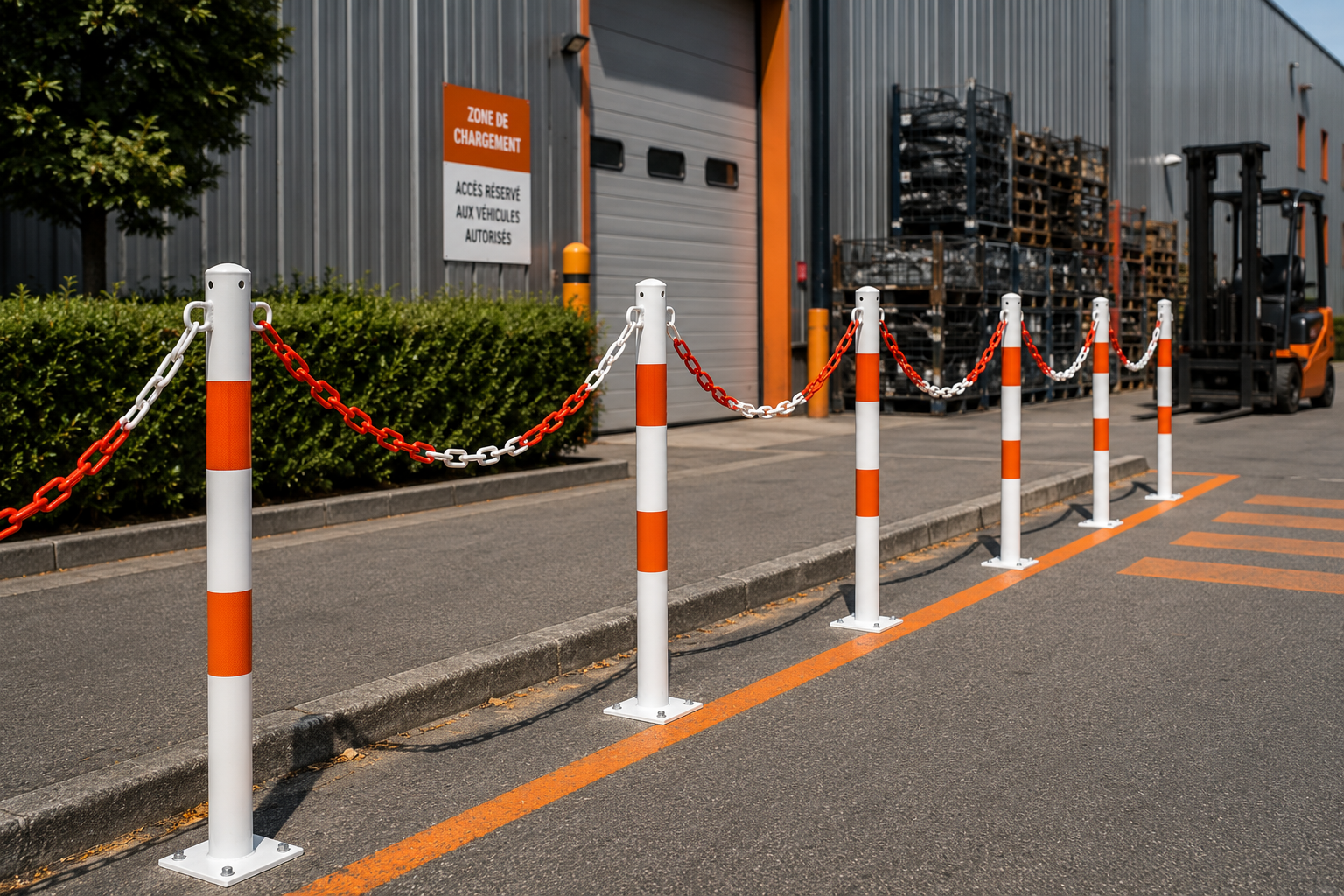
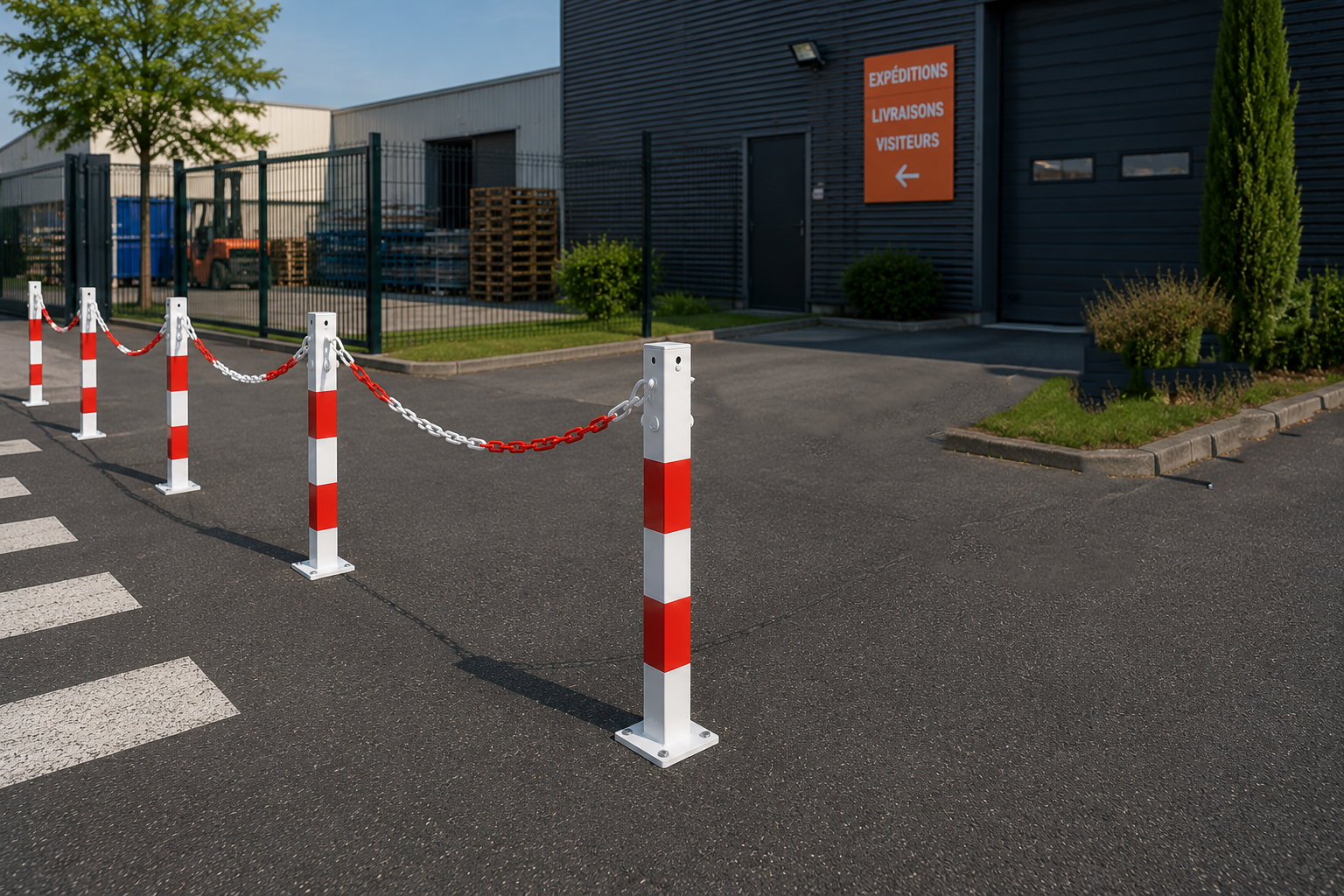
Demarcation posts with chains are used to mark out pedestrian routes, restrict certain access points and improve safety in a wide range of professional and public environments. They guide pedestrians, secure traffic lanes and create temporarily restricted areas. Thanks to their high visibility, they are an effective way to organise movement and reduce the risk of accidents in busy areas.

This equipment can be installed in many locations, such as logistics warehouses, loading docks, car parks, industrial zones, construction sites, shopping centres and public spaces. Demarcation posts with chains are also widely used to separate pedestrian areas from lanes reserved for vehicles or handling equipment. Durable and easy to set up, they suit indoor and outdoor use alike.

Controlling movement in high-risk areas
Efficient access management

Controlling movement in high-risk areas

In industrial, logistics and retail areas, protection posts answer a constant need to organise and secure access. They mark out circulation areas, channel pedestrian and vehicle flows and protect sensitive zones without complex installation. They make movement easier to manage while making everyday safety instructions more visible.

For a coherent organisation of outdoor spaces, this equipment can be installed in car parks, logistics warehouses or on construction sites. It can be complemented with floor marking, directional signs or safety barriers to create a clear, safe environment suited to different professional uses.

Questions fréquentes

Which sizes and heights of rigid bollards should you choose for each use?

The format depends on the application: a city bollard is typically 80 to 100 cm high above ground, with a diameter of 60 to 120 mm in galvanised steel, stainless steel or cast iron. For pedestrian zones or shopfronts, a slim decorative model with a ball top is preferred; for industrial anti-ram protection, diameters rise to 150-273 mm with thick walls. Fixed bollards for concreting are sunk 30-40 cm into a concrete foundation, while baseplate models bolt onto an existing slab. Reflective bands are available to ensure night-time visibility and clearly mark the access boundary.

Can rigid bollards be customised (colour, logo, finish)?

Yes, the city bollard is highly customisable: powder coating in any RAL colour (black, anthracite, green, corporate shades), a brushed stainless or patinated cast iron finish for historic centres, and printing of your logo or municipal crest on the shaft or head. Retro-reflective red/white bands can be added for safety, along with an optional decorative ring. The head can be flat, domed or ball-shaped depending on the desired style. For industrial protection, high-visibility yellow RAL 1023 remains the standard to clearly mark traffic routes, loading-dock corners and pedestrian boundaries.

How much does a rigid bollard cost and what drives the price?

The price of a rigid bollard depends on the material, diameter and installation method. A city bollard in galvanised, powder-coated steel starts at entry level, while a decorative cast iron or brushed stainless model for a historic centre sits notably higher. Large-diameter industrial anti-ram posts, set into a concrete foundation, are the costliest due to wall thickness and reinforced steel. Installation also counts: a baseplate model bolts down quickly, whereas a concrete-set model needs a foundation. Volume discounts apply from just a few units, making fleet orders more economical.

What is the delivery time for rigid bollards?

For standard city bollards and protection posts in galvanised or powder-coated steel, the usual lead time is 2 to 3 weeks, covering preparation and palletised transport. Baseplate models held in stock ship faster, while a bespoke industrial post (reinforced diameter, specific RAL coating, logo) needs a few extra production days. Plan for installation: a concrete-set model requires a foundation that must cure before backfilling, whereas a baseplate version bolts down on receipt. We confirm a firm date at order stage and can advise on staggered deliveries for large projects.

What warranty and lifespan can you expect from a rigid bollard?

A rigid bollard in hot-dip galvanised steel or cast iron is designed to last several decades outdoors. Galvanising provides lasting corrosion protection, and the RAL powder coating improves colour retention against UV and weather. Stainless steel offers maximum resistance in marine environments. Beyond the manufacturer's warranty, real lifespan depends on installation: a correct concrete anchoring and maintained reflective bands ensure effective anti-parking and anti-ram protection over time. Wear parts such as the cap or ring can be replaced without removing the shaft.

Base-plate or set-in post: how should you choose according to the context?

A bolted base plate suits temporary or reversible installations: retail entrance halls, event spaces, co-working areas. Setting into concrete suits permanent sites, outdoor access points or areas with heavy traffic. Also consider the type of ground: concrete, tiling or an existing surface speeds up base-plate installation.

How does a steel post delimit a reception area or protect a shopfront?

The post is strategically positioned to create a psychological or physical barrier. In a reception area, two or three posts mark out a queue or a preferred route. At a shopfront, the post absorbs the impact of an accidental knock instead of that impact damaging the window or structure. The post absorbs the energy, protecting the sensitive area behind it.

Which steel finish should be chosen for durable outdoor use?

The galvanised finish offers the best protection against rust in humid or coastal environments. It requires no surface maintenance. Paint can be applied in an epoxy or polyurethane finish for a custom colour, but will need periodic checking in exposed areas. For covered use, standard paint is sufficient.

What is the difference between a delimiting post and an impact-protection post?

A delimiting post marks out a space and guides traffic flow, without necessarily absorbing heavy impacts. An impact-protection post, particularly indoors in a warehouse or workshop, is designed to withstand repeated impacts from forklift trucks and absorb the energy of those impacts. The latter is therefore more substantial and more robustly installed, to cope with different risks.

Can't find the answer to your question ?

Investing in a rigid bollard rather than a flexible solution or a simple painted ground marking makes sense as soon as the real risk is a vehicle or handling equipment impact rather than mere zone signage. A commercial car park, a delivery dock or a facade bordering a traffic route exposes the building and people to repeated impacts that only a properly anchored rigid barrier can absorb without giving way. Choosing the right model and where to place it depends directly on a proper assessment of the site's actual risk, the type and speed of vehicles operating nearby, how often they pass, and the consequences of an uncontrolled impact on the structure being protected. This upfront analysis avoids both unnecessary over-equipping and dangerous under-sizing.

Where to position bollards for effective protection

How effective a rigid bollard is depends as much on its positioning as on its own strength. It needs to sit close enough to the point being protected to stop a vehicle reaching the facade or sensitive equipment, while maintaining a spacing that keeps the necessary width for pedestrian or vehicle passages. Too wide a spacing leaves a gap a vehicle could pass through; too tight a spacing can obstruct legitimate traffic, particularly for deliveries or wheelchair access.

Section, diameter and height according to risk level

Bollard sizing should match the risk identified on site. A pedestrian area with a low-speed accidental intrusion risk can generally make do with a standard diameter model, while a loading dock exposed to regular heavy goods vehicle or forklift traffic needs a larger section and a reinforced anchor. The above-ground height needs to be enough to intercept a vehicle before any contact with the structure being protected, typically around 80 to 100 centimetres depending on the site layout.

Ground anchoring, the key to real strength

However robust its steel, a rigid bollard is only as good as its anchor to the ground. Bolted base plate fixing needs a sufficiently stabilised surface, a concrete slab of adequate thickness or a reinforced foundation depending on the anticipated level of impact. Inadequate anchoring on an unprepared surface remains the leading cause of failure observed with this type of equipment, well ahead of the metal itself breaking. On a new surface or a freshly poured slab, it's advisable to respect the concrete's full curing time before any fixing, to guarantee the anchor holds over time.

Maintenance and lifespan in outdoor settings

Outdoors, a rigid steel bollard needs a finish suited to the site's exposure, anti-corrosion treatment for damp or coastal environments, and a periodic check of its ground fixing, particularly after any visible impact, however light. An impact that hasn't visibly deformed the steel can still have weakened the anchor, which is why a systematic check is worth doing after any impact noted on site.

Mistakes to avoid before equipping a site

  • Choosing a flexible model where the actual risk calls for rigid protection that won't give way on impact
  • Undersizing the section or height relative to the type of vehicle actually operating on site
  • Neglecting ground preparation before base plate fixing, the leading cause of anchor failure
  • Forgetting periodic checks of the fixing after an impact, even with no visible deformation of the steel

There are 3 products.

Sort by:
Steel impact protection stanchion, three heights yellow and black on plate

Steel Impact Protection Bollard 120cm

Steel impact protection bollard, 120cm height, diameter Ø 7.6 cm, Ø 8.89 cm or Ø 15.9 cm. Galvanized steel with powder-coated yellow/black finish. Fixation by anchor bolts (to...
€130.66
Round steel stanchion on base plate, yellow/black and white/red with attachment ring

Galvanized Steel Round Safety Post with...

Manufactured in steel, round safety posts are resistant and durable, and are used to delimit traffic routes and mark hazardous zones. These posts are easy to install thanks to...
€57.76

Meilleures ventes

Toutes les meilleures ventes ›