Mon pays de livraison :
US UNITED STATES
  • DE Allemagne
  • AT Autriche
  • BE Belgique
  • BG Bulgaria
  • HR Croatia
  • CY Cyprus
  • CZ Czech Republic
  • DK Denmark
  • EE Estonia
  • FI Finland
  • FRC France (Corse)
  • FRD France (DOM-TOM)
  • FR France (Métropolitaine)
  • GR Greece
  • HU Hungary
  • IT Italy
  • LV Latvia
  • LI Liechtenstein
  • LT Lithuania
  • LU Luxemburg
  • NL Pays-Bas
  • PL Pologne
  • PT Portugal
  • RO Romania
  • SK Slovakia
  • SI Slovenia
  • ES Spain
  • CH Suisse
0
0 Cart (empty)
Warehouses and car parks

Wall buffers that absorb forklift and car door impacts

Scuffed walls, chipped corners, dented cladding: in a warehouse or car park, every clumsy manoeuvre leaves costly marks. A polyurethane wall protection buffer soaks up these repeated impacts and makes masonry repairs a rare event.

Its safety yellow or black and yellow colour also flags up the obstacle: drivers correct their line before contact is even made.

Fitting and return on investment

A simple installation that avoids costly repairs

An impact protection buffer fits to a clean wall with a few fixings, without stopping operations. Compare that cost with repairing a wall, replacing a punctured pipe or shutting down a storage area: the equipment pays for itself with the first serious impact it absorbs.

Polyurethane keeps its elasticity for years, indoors and outdoors, with no particular maintenance.

Questions fréquentes

What sizes and dimensions of protection buffers are available for docks and walls?

Our range of rubber dock buffers covers every need: loading bay buffers from 250 to 1000 mm long and 50 to 100 mm thick to absorb the impact of reversing trucks, L-shaped wall and corner protection profiles of 1 m, and cylindrical bollard buffers bolt-fixed to columns. The corner protection models come in heights of 500, 1000 and 2000 mm. Select the thickness according to your forklift tonnage and the traffic frequency in your warehouse, ensuring reliable impact absorption in busy logistics zones.

Are protection buffers customisable (colours, marking, bespoke dimensions)?

Yes, our protection buffers are highly customisable. The standard yellow-black hazard striping provides a compliant, high-visibility danger signage finish, but we also offer RAL shades matching your corporate identity or internal colour code. Dock buffer and corner profile lengths are cut to size, while screen-printed marking or reflective bands boost visibility in low-light areas. For large logistics sites, bespoke marking of traffic lanes and loading zones can be produced on request, helping you align impact protection with your warehouse safety scheme.

How much does a protection buffer cost and what determines the price?

The price of a protection buffer depends on the material, dimensions and the impact energy to be absorbed. A rubber wall corner profile starts at a few dozen euros, while a heavy-duty loading bay dock buffer in solid bolt-fixed rubber sits higher depending on thickness and forklift tonnage. As a direct B2B supplier, we offer volume-based tiered pricing, ideal for equipping every dock and wall corner across a logistics warehouse. Request a quote for a precise costing per reference and quantity, so your impact-protection budget matches your actual traffic exposure.

What is the delivery lead time for warehouse protection buffers?

Standard rubber protection buffers (dock buffers, wall corner profiles, cylindrical buffers) are usually delivered within 1 to 2 weeks thanks to permanent stock. Bespoke versions (cut lengths, specific RAL shades, custom yellow-black hazard marking) require additional lead time depending on production. For a full project equipping loading bays and warehouse corners, we recommend ordering ahead to secure volumes and plan installation by bolt-fixing or bonding across the entire logistics site, avoiding gaps in impact protection during the rollout.

How durable are protection buffers and what warranty applies?

Our protection buffers in rubber and polyurethane are built for intensive industrial use: the elastomer material absorbs impact repeatedly without permanent deformation and resists abrasion, oils and temperature swings. When properly bolt-fixed, dock buffers and wall corner protection retain their effectiveness for several years in a warehouse and logistics environment. Beyond the commercial warranty, real-world lifespan depends on the frequency and severity of forklift impacts; correct sizing for your loading bay traffic significantly extends service life and protects your structures.

Where should buffers be placed to effectively protect walls, furniture and cables?

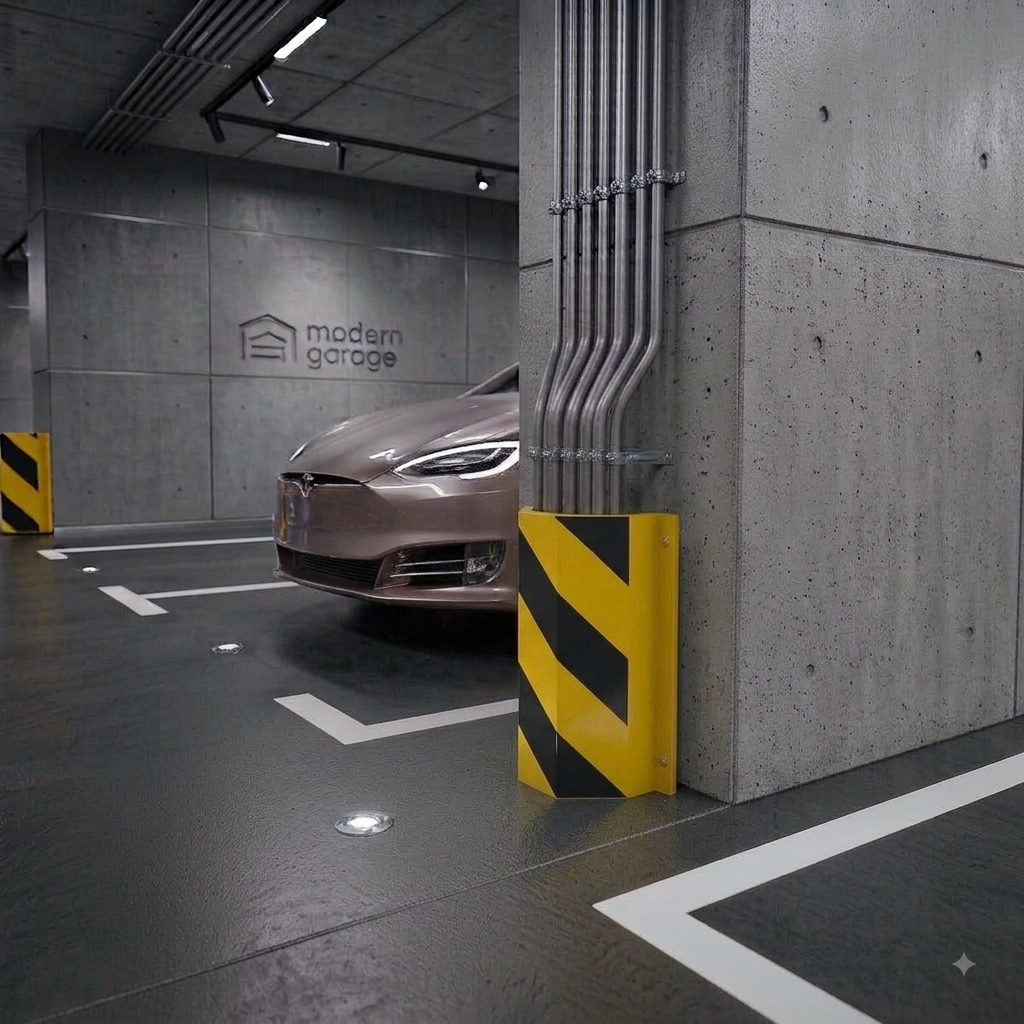
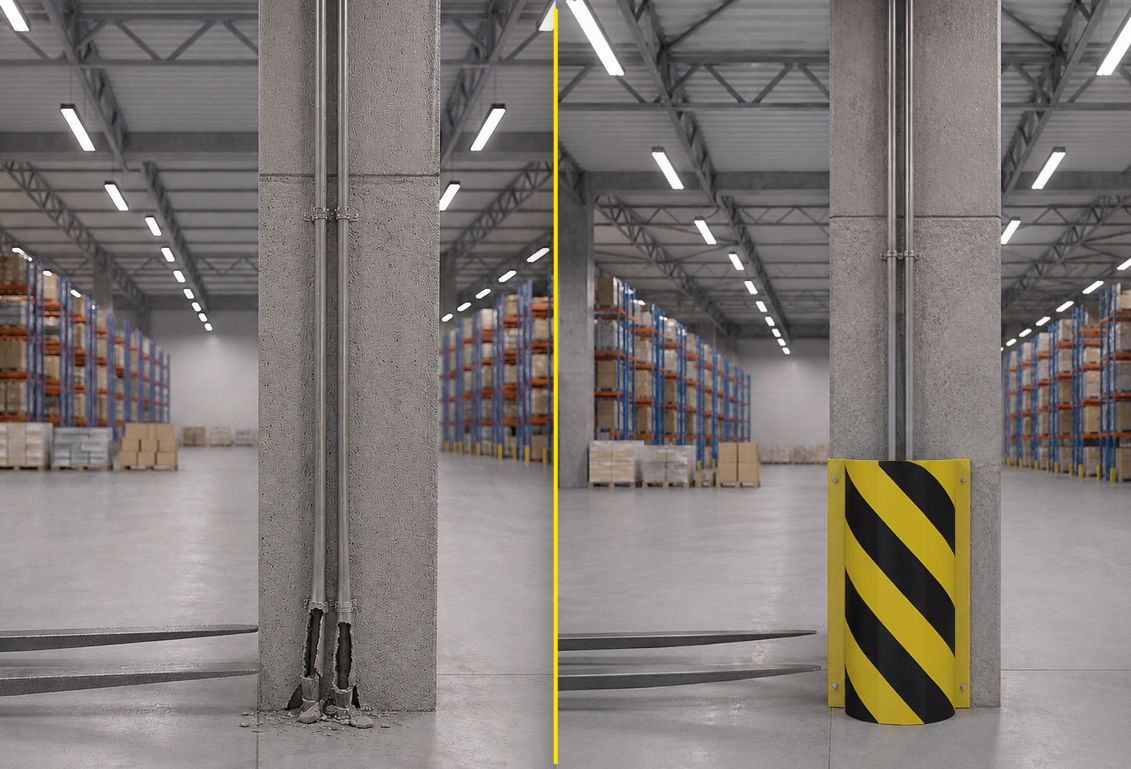
Place a wall buffer at the height where forklift impacts are most common, generally in the middle to lower area of the wall. At corners where two walls meet, a corner buffer is more effective than a single wall buffer. Also protect cable management areas, pipework or ducting: a dedicated buffer wraps around these vulnerable fittings. In high-traffic areas, double up protection on critical corners to maximise durability.

Does polyurethane really absorb repeated forklift impacts?

Yes, the high-density polyurethane used by Stand-Direct is formulated to withstand hundreds of thousands of impacts with no permanent deformation. Each impact compresses the material, which springs back to its original shape once the load is removed. This elasticity is the key feature: it differs radically from the rigidity of concrete or steel, which crack or dent under repetition.

How does a protection buffer reduce repair bills?

Every forklift impact can damage a wall (cracking, partial collapse), an electrical installation, a cable or a piece of equipment. Structural repairs or cable replacement cost far more than a buffer. By absorbing impacts before they reach the structure, the buffer becomes a kind of impact insurance: a one-off investment against a stream of costly, time-consuming small repairs.

Should you choose a wall buffer or a floor buffer depending on the area?

A wall buffer protects the wall itself and its associated fittings (surface-mounted cables, sockets, ducting). A floor buffer protects low-level furniture or equipment bases instead. Combined, they form L-shaped protection covering both risks. Assess the dominant type of impact in your area: side impact suggests a wall buffer, low impact suggests a floor or corner buffer.

Can't find the answer to your question ?

Investing in protective buffers becomes worthwhile as soon as a logistics site records repeated impacts against the same areas: dock corners, rack legs or access points to traffic aisles. Rather than repairing the damage after the fact, identifying recurring impact points helps target installation where it will have the most effect, without equipping the whole site as standard. Return on investment is mainly measured in avoided repair costs, wall repainting, replacement of damaged racking and fewer operational stoppages caused by handling incidents. A site restructuring its flows, or bringing in larger handling equipment, is also a good moment to review its impact protection.

Identifying risk areas before fitting protection

Before installing buffers, a walk around the site helps identify the areas where impact marks keep appearing: rack corners, dock exits, tight bends in narrow aisles. These points account for most incidents and deserve priority protection rather than uniform equipment across the whole building. The installation height should match the vehicles' actual point of contact, usually at bumper or fork height depending on the type of vehicle, otherwise the protection does not do its job in the right place. Poor positioning, too high or too low relative to the actual impact point, remains one of the most common mistakes during fitting.

Which model for which type of traffic

A site used mainly by manual pallet trucks or light equipment does not need the same level of protection as a warehouse crossed by high-capacity forklift trucks. On crossing points and tight manoeuvring areas, continuous strip protection is generally better than individual units, which leave uncovered gaps between fixing points. Conversely, an isolated corner or an exposed column can be protected effectively with a single, well-positioned unit, without over-investing along the whole length of the wall. Matching the level of protection to the actual intensity of traffic avoids both under-equipping at-risk areas and over-investing in low-traffic ones.

Routine maintenance and monitoring over time

A regular visual check helps spot sagging or cracked buffers before they lose their absorption capacity, particularly in very high-traffic areas where wear naturally speeds up. Wall fixings are worth checking periodically for tightness, especially on sites where vibration from passing vehicles is significant. Regularly cleaning the contact surfaces also prevents a build-up of debris that can mask early signs of deterioration. This simple monitoring extends the equipment's effective working life and allows for a planned replacement rather than an emergency repair after a more serious incident.

Mistakes to avoid when installing

Certain mistakes come up regularly when setting up impact protection on a logistics site:

  • Equipping the whole site uniformly without first identifying the areas genuinely exposed to impact
  • Positioning the protection at a height that does not match the vehicles' actual point of contact
  • Overlooking crossing points and tight manoeuvring areas, statistically the most accident-prone
  • Forgetting to review the layout after a change in fleet or in the size of handling equipment

A layout planned around the site's actual traffic, rather than applied uniformly, remains the factor that most determines how effective impact protection stays over the long term.

There is 1 product.

Sort by:
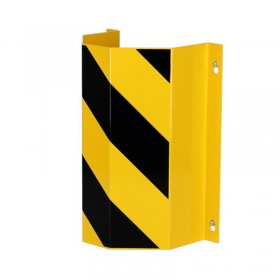
Cable and pipe protection bumper, side view with drilled mounting brackets Cable protector for cables, pipes and conduits installed

Steel Cable and Conduit Protection Bumper

Industrial cable protection bumper for warehouses and factories that prevents workplace accidents, equipment damage and production downtime caused by collisions or impacts from...
€188.30

Meilleures ventes

Toutes les meilleures ventes ›